
Sewing Machine Feet Explained: Which Presser Foot Do You Need?
Quilting, zips, hems, vinyl, gathering or free-motion sewing—the right presser foot can turn a fiddly job into a repeatable one. Here is how to choose the right type and the right fitting for your machine.
 12 foot types.
One clear guide.
A presser foot holds and guides fabric while your sewing machine forms a stitch. The right one can help layers feed evenly, keep a seam exactly ¼ inch wide, fold a narrow hem, insert a zip, finish a raw edge or move smoothly over a sticky material.
Find the right presser foot in 10 seconds
| Your sewing job | Foot to try | Why it helps |
|---|---|---|
| Quilts, matching checks, slippery fabric or several layers | Walking or even-feed foot | Helps the top and bottom layers travel together |
| Accurate patchwork seams | ¼-inch foot | Provides a consistent 6.4 mm seam guide |
| A very narrow double-fold hem | Rolled-hem foot | Folds the fabric through a scroll before stitching |
| A barely visible garment or curtain hem | Blind-hem foot | Guides the fold for tiny catches on the outside |
| Ordinary zip, piping or stitching beside a raised edge | Zipper foot | Lets the needle sew close to the obstruction |
| A concealed garment or cushion zip | Invisible-zip foot | Grooves guide and uncurl the zip coils |
| Neatening a raw woven-fabric edge | Overcasting foot | Supports the edge while the overcast stitch forms |
| Topstitching, joining edges or stitching in the ditch | Edge-guide foot | A blade follows the edge, fold or seam |
| Machine-made buttonholes | Specified buttonhole foot | Works with the machine’s one-step or multi-step process |
| Free-motion quilting, darning or thread painting | Free-motion foot | Supports the fabric while you move it manually |
| Vinyl, faux leather or coated fabric that drags | Non-stick or roller foot | Reduces friction under the foot |
| Soft gathers | Gathering foot | Gathers as a straight stitch is sewn |
| Evenly spaced gathers or pleats | Ruffler attachment | Mechanically forms repeatable tucks |
01Walking foot or even-feed foot
A walking foot adds feeding action above the fabric. The machine’s feed dogs move the lowest layer while the walking foot helps the upper layer travel at a similar rate. This reduces creeping, stretching and seams that start aligned but finish mismatched.
Best for
- Straight-line quilting and quilt binding
- Matching checks, stripes and motifs
- Batting, bulky seams and multiple layers
- Slippery fabrics that move against each other
- Knits that become wavy under an ordinary foot
Direct Sewing lists model-specific walking and even-feed options for Brother, Janome, Singer, Elna and Juki machines. Janome AcuFeed, PFAFF IDT and Husqvarna Viking dual-feed accessories are proprietary systems and should not be treated as interchangeable.

Brother F033N even-feed foot
For compatible Brother electronic machines. Check the model list.

Walking-foot attachment for compatible BERNINA machines
Use only when your exact machine appears on the Direct Sewing product page.
02Quarter-inch or ¼-inch foot
A ¼-inch foot guides an accurate 6.4 mm seam allowance. It is a patchwork essential because a tiny error repeated across several blocks can change the finished size and stop points or seams matching.
- Patchwork piecing and quilt blocks
- Consistent narrow seams
- Small projects with ¼-inch allowances
- Edge stitching at a set distance
Some versions use the right-hand edge as the guide; others add a metal flange. Check the required needle position before sewing. A straight-stitch opening gives control but cannot safely accommodate a zigzag stitch.

03Rolled-hem or narrow-hemmer foot
A rolled-hem foot has a scroll that turns the fabric edge under twice before it reaches the needle. The result is a clean, narrow hem without pressing the whole edge first.
Use it for shirt tails, scarves, handkerchiefs, napkins, ruffles, flounces and fine table linen. Different feet create different finished widths: a 2 mm hem is much finer than a 4 mm or 6 mm hem.
A smoother start
- Cut a clean, square fabric edge.
- Manually double-fold the first few millimetres.
- Sew several anchoring stitches.
- Guide a consistent amount of fabric into the scroll.
- Keep the raw edge inside the curl without forcing it.
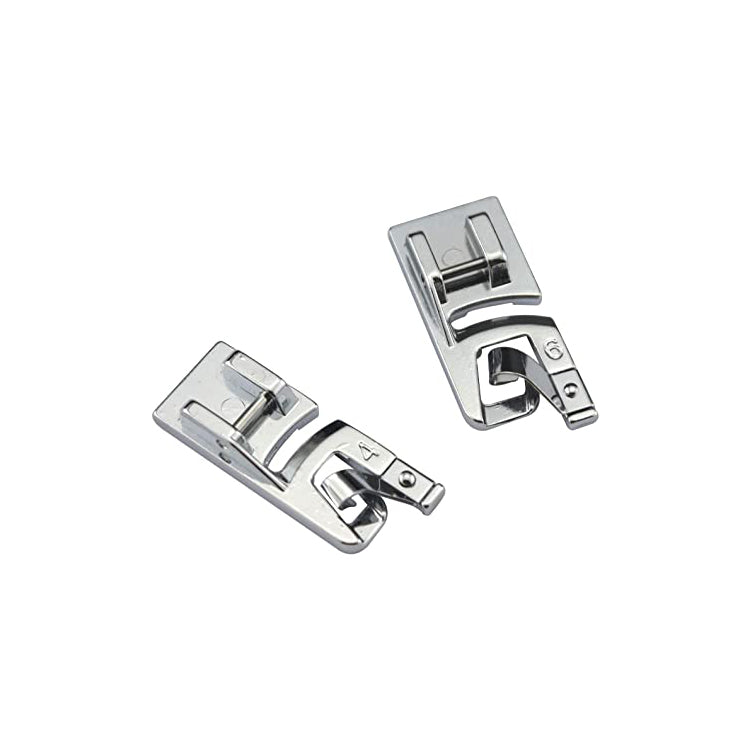
Other options include the generic narrow hemmer for compatible snap-on machines, separate Brother feet for electronic and mechanical machines, and the Singer 4 mm rolled-hem foot.
04Blind-hem foot
A blind-hem foot guides a specially folded hem while the machine alternates between stitches in the hem allowance and an occasional stitch that catches just a few threads of the outer fabric. Once opened and pressed, only tiny catches should show.
Ideal for
Trousers, skirts, dresses, jackets, curtains and other home furnishings.
The secret
Test the needle swing first. If the needle takes too large a bite from the fold, the stitch will be visible outside.
Direct Sewing lists the Singer blind-hem foot, Brother F017N for compatible electronic machines and Brother F018N for compatible mechanical machines.
05Zipper foot and invisible-zip foot
Standard zipper foot
Narrow enough to sew close to ordinary zip teeth, piping, welt cord, D-rings and raised seams. It may attach on either side or work with an adjustable needle position.
Invisible-zip foot
Grooves underneath guide and uncurl the concealed zip coils so the needle can sew closely beside them. It is not simply a narrower ordinary zipper foot.

Brother F080AP concealed-zip foot
Designed to guide the coils on compatible Brother machines.
06Overcasting or overedge foot
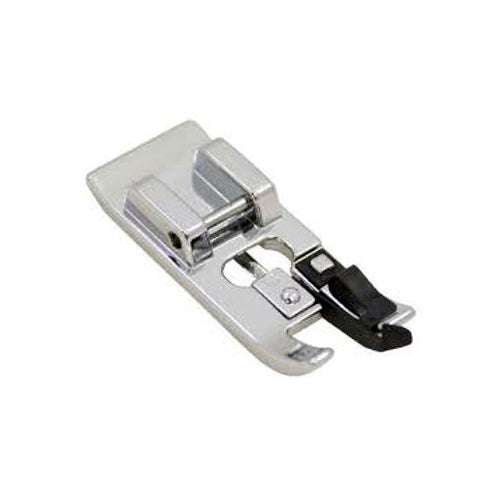
An overcasting foot supports the raw edge while a domestic machine forms an overcast or zigzag-style stitch. Its guide or stitch finger helps stop the edge tunnelling into a ridge.
07Edge-stitching, edge-joining and stitch-in-the-ditch feet
These feet use a blade or guide to follow an existing edge, fold or seam. Brand names vary, and one foot may perform several related jobs.
- Even topstitching beside a fold
- Stitching in the ditch
- Joining lace, trims or finished edges
- Understitching and precision seam work
Position the guide first, then adjust the needle position or stitch width. Turn the handwheel through a complete stitch cycle before sewing under power.
Relevant options include the Brother F056AP edge-joining foot, Brother F065N stitch-in-the-ditch foot, Singer edge-joining foot and Janome 7 mm edge-guide foot.
08Buttonhole foot
The foot must suit both the attachment system and the buttonhole process built into the machine. A long one-step foot often holds the button at the rear so a compatible machine can determine the finished length. A shorter four-step foot uses markings while you control the stages separately.
Direct Sewing options include a buttonhole foot for compatible domestic machines, Brother one-step foot A, Singer one-step buttonhole foot, Janome automatic foot R for compatible 7 mm machines and a Juki foot for specified HZL models.
09Free-motion, darning or quilting foot
A free-motion foot holds the fabric near the needle as the needle exits, reducing the chance that the material lifts with it. With the feed dogs lowered or covered, you move the fabric manually in any direction; your hand movement and machine speed determine the stitch length.
Use it for
- Free-motion quilting and stippling
- Thread painting and freehand embroidery
- Darning and repairing worn fabric
- Ruler work—with the correct ruler foot, mode and rulers
Open-toe feet improve visibility. Closed-toe feet provide more complete support. Follow the instructions for your exact model, especially if it has a floating-foot or free-motion mode.

Other choices include the Singer darning and embroidery foot and Janome free-motion set for compatible 7 mm low-shank machines, plus model-listed PFAFF, Husqvarna Viking and Juki options.
10Teflon-style, non-stick and roller feet
A non-stick foot is usually the first choice when vinyl, faux leather, oilcloth, laminated fabric or another coated surface drags beneath an ordinary metal foot. A roller foot uses small rollers and can suit grippy, textured, napped or bulky surfaces.
Surface sticks?
Try a non-stick or roller foot to reduce friction between the material and the foot.
Layers creep?
Try a walking or integrated dual-feed foot to control movement between the layers.

Brother F007N non-stick foot
A low-friction sole for compatible Brother machines.
Also test the correct needle, thread, stitch length and presser-foot pressure. Use clips rather than pins on materials where holes will not recover.
11Gathering foot
A gathering foot creates soft fullness as a straight stitch is sewn. Some designs can gather one layer while attaching it to a second flat layer. The result depends on fabric weight, stitch length, upper tension and speed, so always test a measured strip first.
- Best on light to medium fabrics
- Useful for ruffles, skirts, sleeves and tiered garments
- Longer stitches and higher tension often increase fullness
- Test first to estimate the gathering ratio

Also see the Brother F012N, Janome 7 mm gathering foot and Juki gathering foot for specified domestic models.
12Ruffler attachment
A ruffler is a larger mechanical attachment. Its fork or blade pushes fabric into regular tucks before they reach the needle, making it useful for long runs of more repeatable gathers or pleats.
Choose a gathering foot
For softer, continuous gathering with a compact attachment—especially on lightweight fabric.
Choose a ruffler
For more regular gathers or pleats, adjustable fullness and repeatable spacing.

Direct Sewing also lists the Brother F078AP ruffler, Janome 9 mm ruffler and other model-specific Janome options.
Will any presser foot fit any sewing machine?
No. Some low-shank snap-on feet fit several domestic machines, but presser feet are not universally interchangeable. Compatibility can depend on the shank, attachment method, maximum stitch width, needle position, holder, feed system and exact model.
Snap-on foot
Clips onto the existing foot holder. Quick to change, but the sole still needs the correct width and needle clearance.
Screw-on attachment
Usually replaces the holder and fastens to the presser bar. Common for walking, ruffler and some free-motion feet.
| Brand or system | What to check before buying |
|---|---|
| Brother | Exact model and whether the accessory is for a mechanical or electronic machine. Match the Brother accessory code where possible. |
| Janome | The 5 mm, 7 mm or 9 mm category; low or high shank; and whether the machine uses AcuFeed. |
| Singer | Most current feet here use low-shank or snap-on fittings, but model families, vintage machines and slant-shank machines vary. |
| Elna | Front-loading or top-loading design, stitch-width category and exact model. |
| Juki | The machine family. HZL accessories are model-listed; straight-stitch TL-series feet form a separate family. |
| PFAFF | The accessory group letter and whether the foot is designed for the IDT Integrated Dual Feed system. |
| Husqvarna Viking | The numbered machine group stated on the product. Dual-feed and free-motion accessories must match the group. |
| BERNINA walking-foot attachment | Use only the Direct Sewing walking-foot attachment when the exact model appears on its product page. |
How to change a presser foot safely
- Turn the machine off.
- Raise the needle to its highest position and lift the presser foot.
- Release the snap-on foot, or remove the holder screw if required.
- Fit the new foot exactly as described in the machine or accessory instructions.
- Select the correct stitch and needle position.
- Turn the handwheel slowly towards you through at least one complete stitch cycle.
- Confirm that the needle clears the foot, needle plate and guide.
- Test the setup on an offcut of the actual project fabric.
Which presser feet should a beginner buy first?
First check the accessory tray that came with your machine. Many machines already include an all-purpose foot, zipper foot, buttonhole foot and blind-hem or overcasting foot.
- Quilting: ¼-inch foot and compatible walking foot
- Garments: invisible-zip, blind-hem and narrow-hem feet
- Bags and vinyl: non-stick or roller foot plus zipper foot
- Decorative sewing: edge-joining, gathering or ruffler
- Free motion: model-compatible darning or quilting foot
- Best rule: buy for a real project, not just the collection
Frequently asked questions
Are sewing machine presser feet universal?
No. Some low-shank snap-on feet fit several brands, but compatibility also depends on the holder, stitch width, needle clearance, feed system and exact model.
How do I know whether my sewing machine is low-shank?
Check the machine manual or manufacturer’s accessory chart. If that information is unavailable, send Direct Sewing the full model number and clear photos of the foot holder and mounting screw rather than guessing from appearance.
Can Brother presser feet fit Janome, Singer or Elna machines?
Some basic generic snap-on soles fit several compatible low-shank machines, but a Brother-branded foot is not automatically cross-compatible. Check screw-on attachments, buttonhole feet, walking feet and stitch-width-specific feet by model.
Can I use a 7 mm foot on a 9 mm sewing machine?
Only if the machine or foot manufacturer explicitly confirms it for the intended stitch and needle position. A foot may clip on but still have insufficient needle clearance.
Is a walking foot the same as a Teflon foot?
No. A walking foot helps multiple layers feed together. A non-stick foot reduces friction when vinyl or another grippy material drags under the foot.
Does an overcasting foot cut fabric?
A standard overcasting foot does not cut. It supports the raw edge while the machine forms an overcast stitch. A separate side-cutter attachment can trim on compatible machines.
Do I need a special foot for an invisible zip?
An invisible-zip foot gives the best control because grooves underneath guide and uncurl the coils. A standard zipper foot is normally used for ordinary zips and to close the seam below an invisible zip.
What is the difference between a gathering foot and a ruffler?
A gathering foot creates soft fullness using stitch length, tension and the shape of the foot. A ruffler mechanically forms more regular gathers or pleats and usually gives more control over spacing.
Still not sure which foot fits?
Find the brand and full model number on your machine, then tell us the job you want to complete. A photo of the current foot and holder can help our team identify the correct fitting.
Stock and supplier specifications can change. Always confirm the current compatibility information on the product page before ordering.