
Leather goods
Manage suitable soft-to-medium leather layers through bags, straps, panels and visible seams.
A 1541-style industrial walking-foot machine for leather, upholstery, canvas, vinyl, bags and outdoor products. Genuine compound feed controls demanding layers, while the safety clutch helps protect the hook drive if a severe thread jam occurs.
 MS-1541S | safety clutch
The MS-1541S is designed for sewing rooms where a normal bottom-feed machine cannot keep complex layers aligned and a basic top-and-bottom-feed machine needs more help at dense transitions.
Manage suitable soft-to-medium leather layers through bags, straps, panels and visible seams.
Control furniture covers, cushion construction, piping and suitable automotive interior work.
Sew covers, awnings, bags and outdoor assemblies with the complete stack held together.
Gain positive feeding as bags and technical products build into denser intersections.
Reduce relative movement through grippy, coated or difficult-to-feed surfaces.
Use the familiar flat-bed layout for repeat heavy-material straight-stitch operations.
The feed dog, needle and inner presser foot move together through the feeding phase. The outer foot alternates to hold the assembly while the feeding components return for the next stitch. This system is also called unison feed or triple feed.
A heavy thread jam or obstruction can place sudden force on the hook-driving mechanism. The MS-1541S safety clutch is designed to disengage that drive before the force causes more serious mechanical damage.
The clutch is a protective mechanism, not permission to force the machine. Stop immediately when it disengages, switch the machine off, remove the cause and follow the correct reset procedure.
Within the familiar 1541-style naming, the S identifies the safety-clutch version. That is the meaningful difference customers should see in the title, not just a letter buried in the model number.
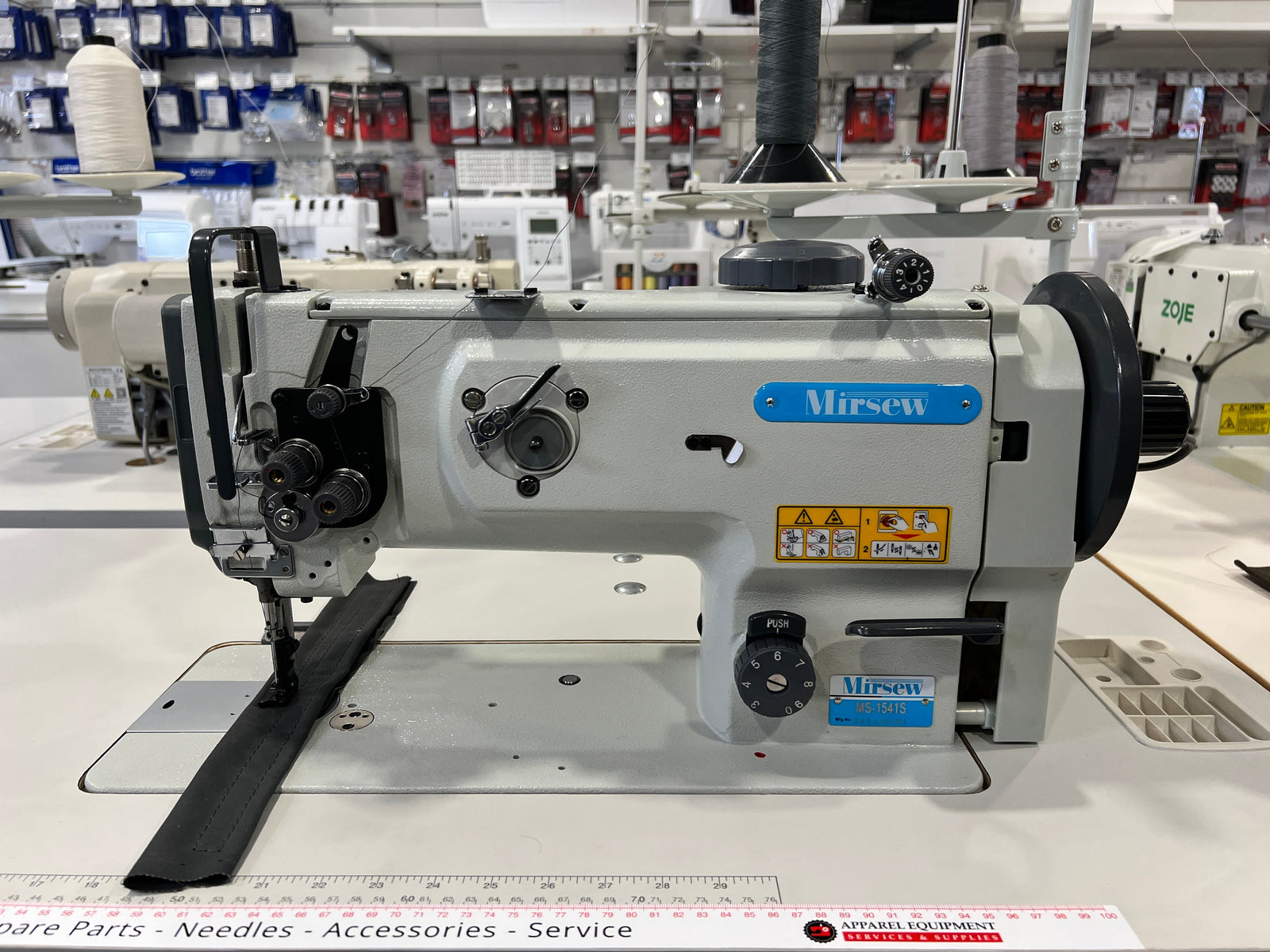
The current photograph shows the Mirsew-branded MS-1541S machine head, walking-foot mechanism, stitch-length controls, side-loading hook area and conventional belt-driven handwheel arrangement.
Broad panels, covers and bag components remain supported around the sewing area.
Access the large-capacity hook from the side without changing the basic position of the work.
Secure seam beginnings and endings with direct operator control.
Set the stitch to suit construction, reinforcement or visible topstitching.
Raise the presser feet while keeping both hands available to control the material.
Fit suitable piping, zipper or specialist walking feet for the operation.
The current package uses an energy-saving servo motor rather than a continuously running clutch motor. It drives the head through a conventional belt, giving the workshop adjustable speed with familiar mechanical serviceability.
Limit the maximum speed for learning, detail work and bulky seam crossings.
Sew anywhere up to the selected limit rather than operating only at one fixed pace.
The servo motor stays quiet while the operator pauses and repositions the work.
Begin accurately at an edge or corner before increasing speed on a long seam.
The motor and belt are separate from the head, following the conventional industrial setup.
Reduce speed before piping, webbing and abrupt changes in thickness.
Panels, handles, straps and suitable reinforcement assemblies.
Cushion covers, furniture panels, piping and welting.
Suitable seat-cover materials, vinyl and trim assemblies.
Canvas, flexible PVC and suitable outdoor cover construction.
Long straight seams through appropriate technical textile stacks.
Binding, webbing, boxed corners and reinforced construction.
Layered and lightly padded work that benefits from compound feed.
Rug construction and repair with the needle and thread matched to the stack.
Create strong construction seams and longer visible stitches on suitable upholstery, canvas and leather.
Gain useful clearance when positioning a bulky assembly beneath the alternating feet.
Carry more bobbin thread for longer seams and appropriately heavier thread setups.
Use the specified industrial system with the size and point selected for the job.
Balance productive straight runs with slower control through corners and intersections.
Keep more of the seam stack under positive control throughout each feed cycle.
Both listings offer compound feed, a 9mm stitch, 16mm lift and adjustable servo speed. The decision comes down to the drive layout and safety clutch.
| Feature | Mirsew MS-1541S | Zoje ZJ1541-BD |
|---|---|---|
| Feed system | Compound or triple feed | Compound or triple feed |
| Motor layout | Separate energy-saving servo motor with conventional belt drive | Integrated direct-drive motor on the machine head |
| Safety clutch | Included and central to this model | Not stated in the current product information |
| Maximum stitch | 9mm | 9mm |
| Maximum foot lift | 16mm | 16mm |
| Best reason to choose | Traditional 1541-style layout with added hook-drive protection | Clean integrated drive with compound-feed control |
The MS-1541S provides the feeding platform, but the final result still depends on the complete setup. Match every element to the material and construction rather than expecting one adjustment to suit every project.
Use every layer, including binding, piping and reinforcement.
Begin slowly with a suitable needle, thread and stitch length.
Check alignment, tension, marking, feeding and seam strength.
| Brand | Mirsew |
|---|---|
| Model | MS-1541S |
| Machine type | Industrial single-needle straight-lockstitch compound-feed walking-foot machine |
| Feed system | Unison or triple feed using the feed dog, needle, inner foot and alternating outer foot |
| Safety mechanism | Safety clutch for the hook-driving system |
| Material setup | Heavy-material industrial sewing |
| Motor | Energy-saving servo motor with conventional belt drive |
| Maximum sewing speed | Up to 2,000 stitches per minute |
| Maximum stitch length | 9mm |
| Maximum presser-foot lift | 16mm |
| Needle system | DPx17 / 135x17 industrial needles |
| Hook | Large-capacity side-loading rotary hook |
| Speed control | Adjustable maximum speed through the servo-motor controls |
| Reverse | Manual reverse lever |
| Stitch type | 301 two-thread straight lockstitch |
| Bed type | Flat bed |
| Workstation | Complete industrial table, steel stand, pedal system, thread stand and wheels |
The MS-1541S is supplied as a complete industrial workstation rather than a loose machine head. Table and stand colour or finish may vary from the photograph.
Switch the machine off and do not continue pressing the pedal after the clutch releases.
Remove trapped thread or material safely before attempting the correct reset procedure.
Replace a bent, burred or damaged needle and inspect for contact around the hook.
Remove lint, fragments and loose thread from the hook, feed dog and needle plate.
Use the specified clear industrial sewing-machine oil and follow the supplied instructions.
Timing, hook clearance, clutch adjustment, feed synchronisation and electrical work require industrial-machine expertise.
Compare top-and-bottom feed, needle feed and compound feed before choosing your workstation.
Read the Feed GuideSelect the correct needle size and point for canvas, upholstery textiles, coated materials and related work.
Shop DPx17 NeedlesA durable poly-cotton upholstery thread option for suitable construction and topstitching applications.
View Oxella 35 ThreadIt is an industrial single-needle flat-bed straight-lockstitch machine with compound feed, alternating walking feet, a large side-loading hook and a safety clutch.
The feed dog, needle and inner presser foot move the material together while the outer foot alternates to hold the work. It is also called unison feed or triple feed.
It gives positive control over layers that want to move at different rates, including leather, vinyl, canvas, piping, webbing and reinforced seam assemblies.
It is designed to disengage the hook-driving mechanism when a severe jam or obstruction creates excessive force, helping reduce the risk of more serious damage.
Stop immediately, switch off the machine, clear the cause safely and inspect the needle and hook area. Reset it only by the correct procedure. Seek technical help if the cause or reset is uncertain.
No. It is an additional protective mechanism, not a substitute for correct needles, threading, setup and operation. Never force the machine through a jam.
It describes the familiar flat-bed, side-loading compound-feed format, with the S identifying the safety-clutch version. This listing is specifically for the Mirsew MS-1541S.
It is intended for suitable leather goods, upholstery, canvas, vinyl, PVC, bags, luggage, outdoor products, quilted goods and horse rugs. Test the complete seam stack.
Yes, suitable soft-to-medium leather goods are a key application. Leather temper, density, total thickness, thread, needle point and seam construction all affect the result.
No. Very dense harness leather, rigid saddlery and extreme stacks may require a heavier cylinder-arm or leather-stitching platform.
Yes. Compound feed is especially useful for upholstery panels, piping, welting, foam-backed materials and intersections where layers tend to move differently.
Yes, suitable canvas and webbing assemblies are strong applications. Test the real stack, including folds and reinforcement.
There is no single reliable thickness figure for every material. The 16mm lift is positioning clearance, not guaranteed sewing capacity. Density, compressibility, thread, needle and seam shape determine the practical limit.
The current MS-1541S listing specifies a maximum stitch length of 9mm.
The listed maximum is up to 2,000 stitches per minute. Reduce the speed for learning, corners, piping and abrupt changes in thickness.
Yes. The energy-saving servo motor lets the operator set a suitable top speed, then use the pedal for variable control up to that limit.
No. The current MS-1541S uses a separate servo motor and conventional belt drive. It remains quiet while idle and offers adjustable speed.
Automatic thread trimming is not stated for the current MS-1541S package.
No. It sews straight lockstitch and reverse only. Choose an industrial zigzag machine when side-to-side needle movement is required.
It uses DPx17 industrial needles, also commonly identified as 135x17. Select the correct size and point for the material and thread.
Use a compatible 135x16 leather point when appropriate for the leather. Cutting-point leather needles should not be used on ordinary woven textiles.
It carries more bobbin thread than a standard-capacity hook, reducing interruptions across long seams and supporting appropriately heavier thread setups.
No. It has a flat bed that supports broad panels. Narrow tubes and tight three-dimensional work may be easier on a cylinder-bed machine.
The current package includes the Mirsew head, safety clutch, servo motor, industrial table and stand, pedal system, knee lift, thread stand, wheels, oil, bobbins, screwdriver and needles. Table or stand finish can vary.
The Mirsew MS-1541S combines proven 1541-style handling, genuine triple feed, a 9mm stitch and adjustable servo control for serious leather, upholstery, canvas and bag-making work.