

Alteration rooms
Efficient hems, seams, repairs, zips, linings and garment adjustments with automatic finishing at each seam end.
A genuine JUKI direct-drive lockstitch machine built for the everyday seams that keep a sewing room moving—clean starts, consistent straight stitching, automatic backtacks and thread trimming at the pedal.
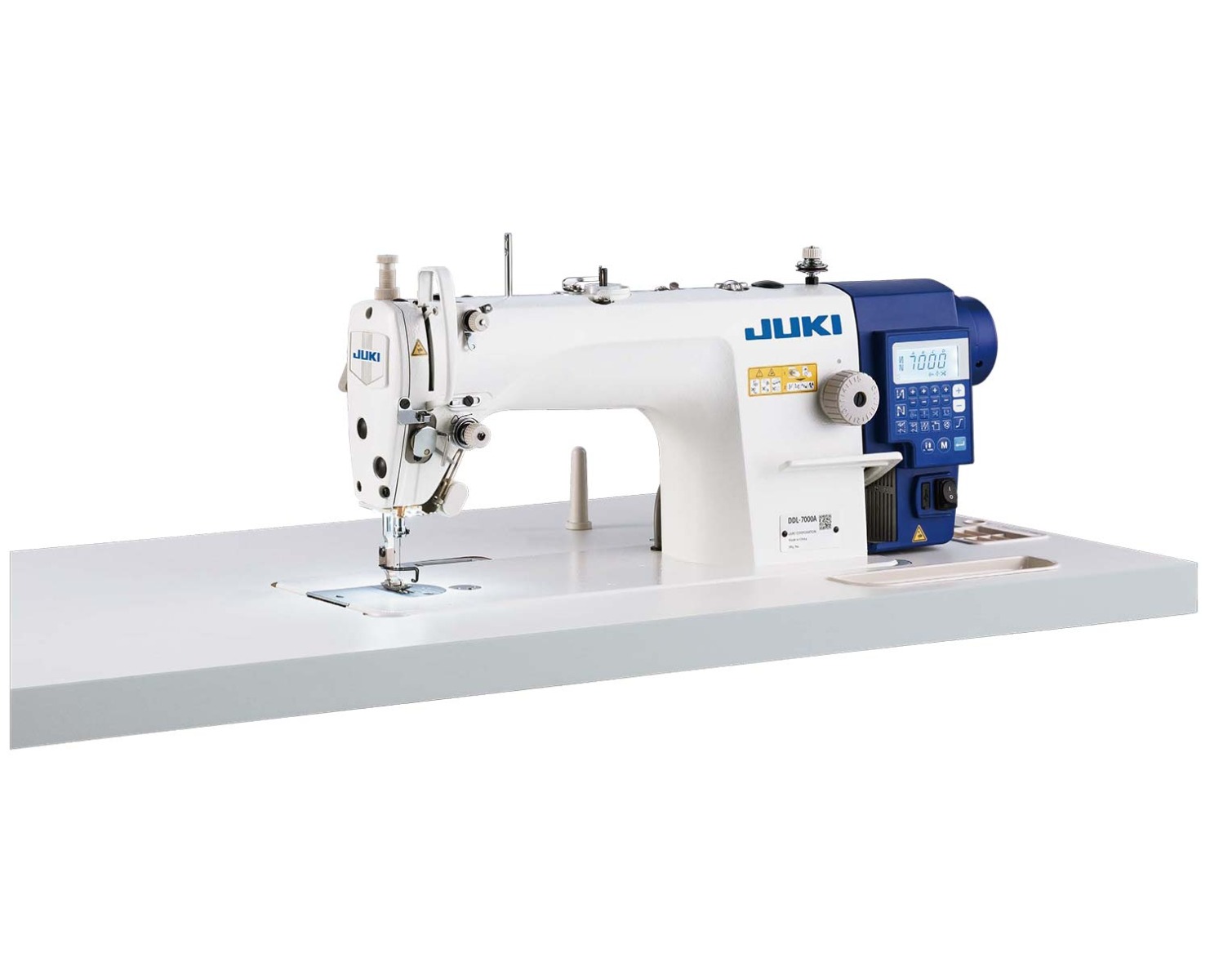 DDL-7000AS-7 · Genuine JUKI
Choose the DDL-7000AS-7 when straight seams make up most of your day and domestic-machine extras matter less than speed, control and repeatable workflow.
Efficient hems, seams, repairs, zips, linings and garment adjustments with automatic finishing at each seam end.
Reliable straight construction on common woven and suitable knit garments, from samples to repeat production.
A compelling first industrial machine for sewists who have the dedicated space and primarily need straight stitch.
Pillowcases, cushions, light curtains, table linen, bedding and other projects with long, clean seams.
Programmable backtacks and trimming reduce hand movements across repeated operations.
Set a lower maximum speed for learning, then increase it as control and confidence grow.
These Direct Sewing photographs show the DDL-7000A platform, integrated control panel, working area, bobbin winder and assembled table setup.
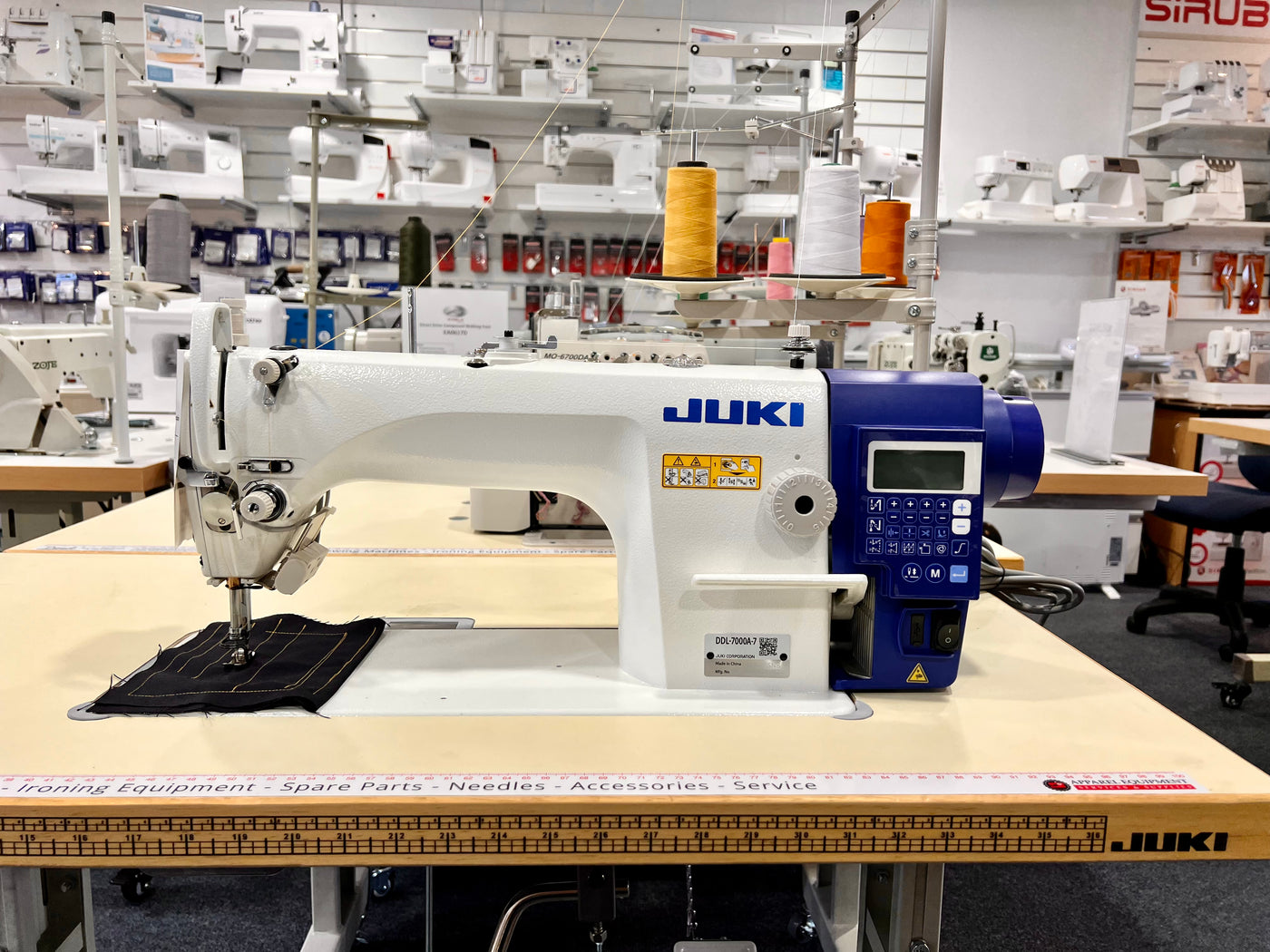
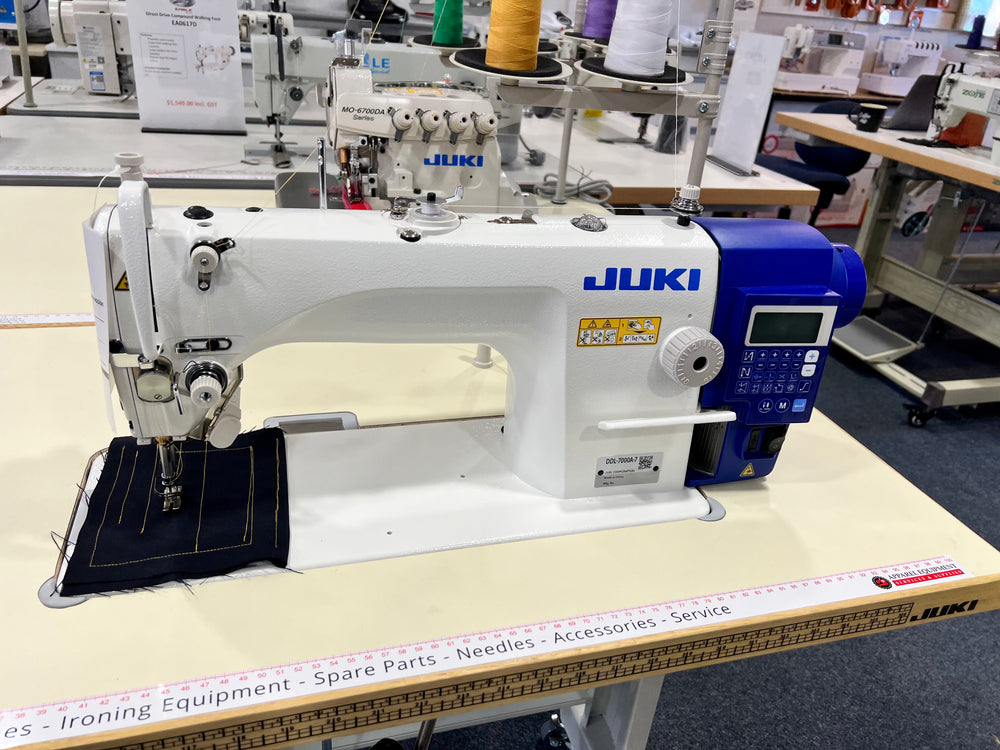
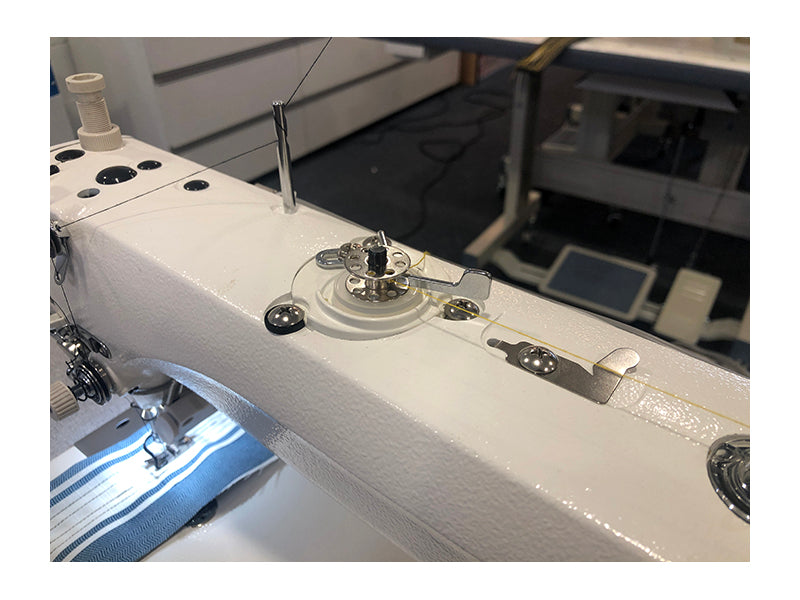
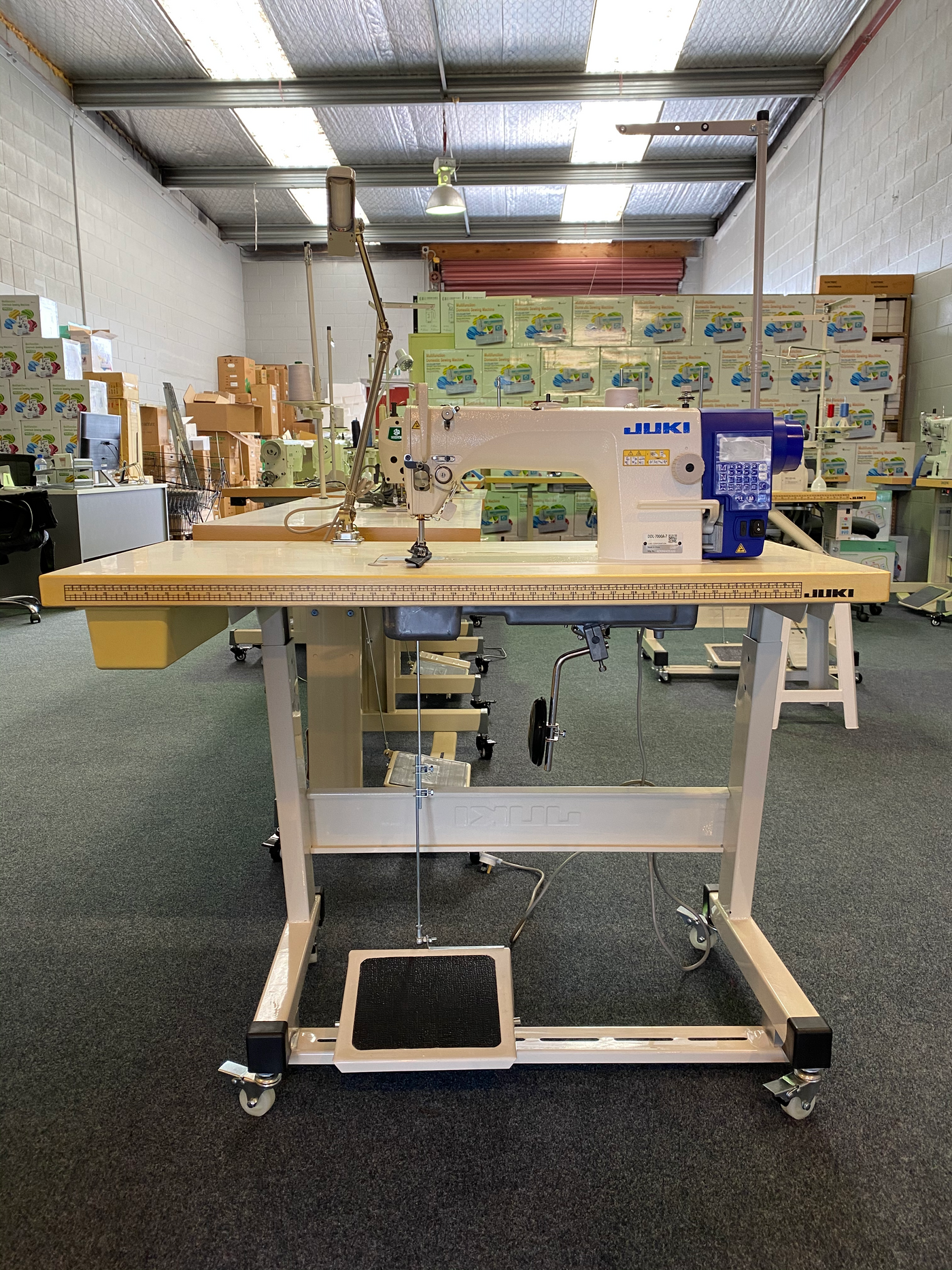
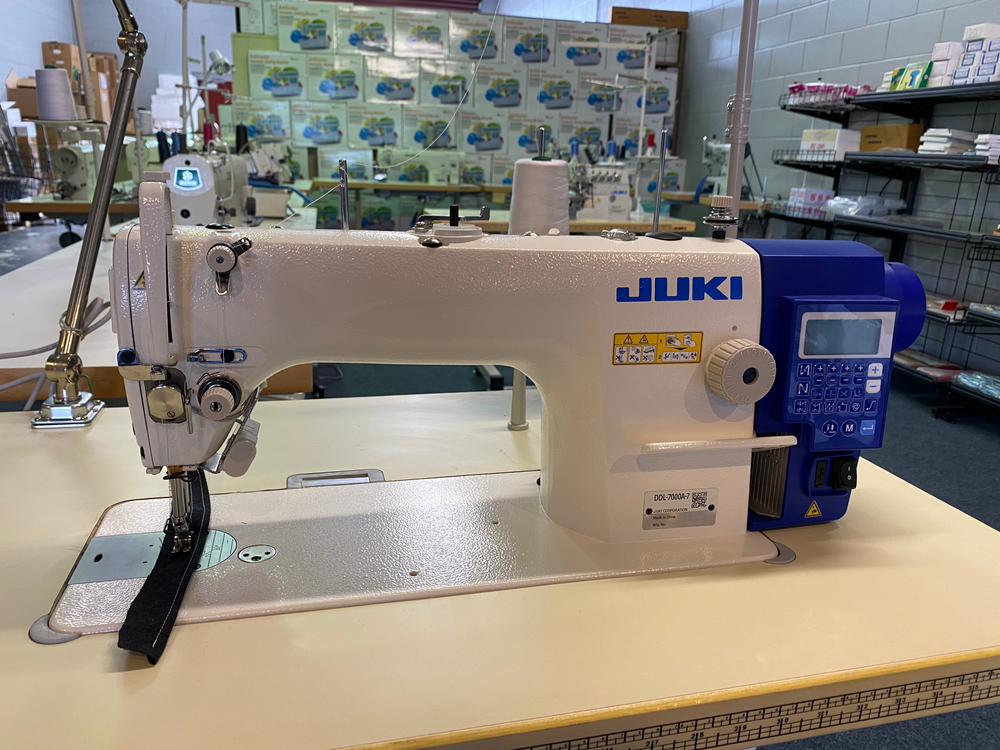
The energy-saving AC servomotor is integrated with the machine head. This gives the DDL-7000AS-7 quick start-up, strong needle penetration and responsive pedal control without the constant idle noise associated with an old clutch-motor workstation.
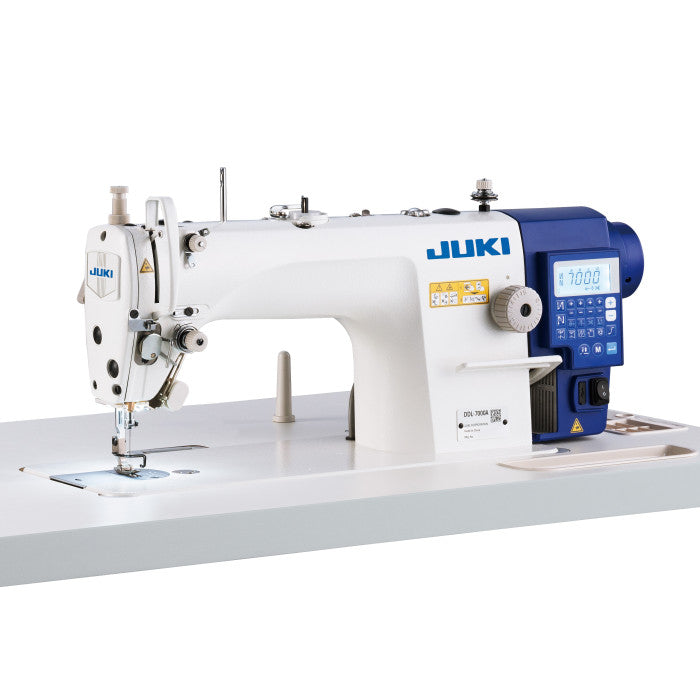
The DDL-7000AS-7 earns its place over a basic plain sewer by automating the repetitive actions surrounding the stitch—not by complicating the core sewing experience.
Complete the programmed pedal action and the machine cuts the needle and bobbin threads, reducing scissor work and long thread tails.
Set automatic reverse stitches at the beginning and/or end for consistent seam locking across repeat operations.
Programme the needle to stop up or down to match your handling preference and the operation being sewn.
The adjustable lever near the needle gives quick manual reverse control, with JUKI's shaft-angle control helping reduce needle breakage risk.
Set a sensible top speed rather than relying on pedal finesse alone—valuable for new industrial users and precise work.
Light reaches the needle entry area from both sides of the needle bar, with five brightness levels for the task and room.
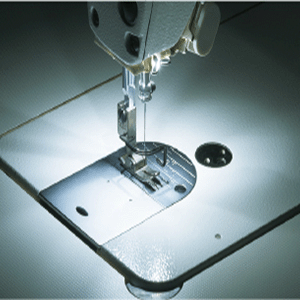
The standard LED system illuminates from the right and left of the needle bar, reducing the harsh shadow created by a single light direction. Adjust the brightness at the panel for dark fabrics, pale reflective cloth or changing room light.
The animation is supplied by JUKI and demonstrates the DDL-7000A lighting system.
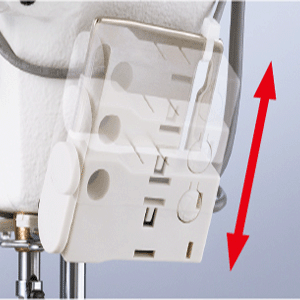
The touch-back switch sits close to the sewing area for immediate manual reverse. Its height can be adjusted to suit the operator and operation, while electronic shaft-angle control helps prevent needle damage when reverse is requested.
This is especially useful when you need manual judgement rather than a pre-programmed backtack—for example, reinforcing a stress point or matching an existing seam.
All three are excellent straight-stitch choices. The decision is how much of the start-and-finish workflow you want the machine to automate.
| Feature | JUKI DDL-8700 | DDL-7000AS-7 This model |
DDL-7000AS-7FL |
|---|---|---|---|
| Best reason to choose it | Proven industrial straight stitch with modern external servo | Direct drive plus automatic backtack and trimming | Full automatic workflow including presser-foot lift |
| Material setup | Light to medium | Light to medium | Light to medium |
| Maximum speed | Up to 5,500 spm in JUKI specification; local setup may be lower | Up to 5,000 spm below 4mm stitch length | Up to 5,000 spm below 4mm stitch length |
| Maximum stitch length | 5mm | 5mm | 5mm |
| Motor | External under-table servo in Direct Sewing package | Integrated direct-drive servo | Integrated direct-drive servo |
| Automatic thread trim | No | Yes | Yes |
| Programmable automatic backtack | No | Yes | Yes |
| Automatic presser-foot lift | No | No—manual lever or knee lifter | Yes |
| Best fit | Value-focused straight-stitch workstation | The strongest balance of automation and value | Maximum hands-free handling for repeated production |
Cotton, linen, shirting, suiting, uniforms, workwear panels and many common garment fabrics.
Trouser hems, side seams, zips, repairs, linings and everyday tailoring operations.
Denim garment construction with the right DB × 1 needle, thread, setup and reduced speed at bulky junctions.
Cushions, pillowcases, bedding, light curtains, napery and other long-seam projects.
Straight construction where appropriate, using correct ballpoint/stretch industrial needles and careful testing.
Some soft garment leather with the right needle, thread and foot—test first and avoid heavy leather assemblies.
Fast, controlled prototyping across varied light-to-medium fabrics without a clutch motor's constant running.
Consistent seam starts and finishes when the backtack pattern and speed ceiling are set for the operation.
| Full model | JUKI DDL-7000AS-7; light-to-medium material configuration |
|---|---|
| Machine type | Industrial single-needle, bottom-feed, straight lockstitch machine |
| Drive | Main-shaft direct drive with integrated 550W AC servomotor |
| Control system | Operation panel, control box and power switch integrated with machine head |
| Maximum sewing speed | Up to 5,000 stitches/min below 4mm stitch length; up to 4,000 stitches/min at 4mm or longer |
| Factory-set speed | 4,000 stitches/min; the operator can set a lower ceiling to suit the work |
| Maximum stitch length | 5mm |
| Needle system | DB × 1 / 16x231 / 134; #14 standard, #14–18 supported |
| Supported thread range | JUKI specification: approximately #60 to #8 / 200–600 dtex; suitability depends on needle and material |
| Needle-bar stroke | 30.7 ± 0.5mm for the AS configuration |
| Presser-foot lift | 5.5mm by hand lever; up to 13mm by knee lifter |
| Automatic functions | Thread trimming and programmable reverse/backtacking; no automatic foot lift on this SKU |
| Lighting | Built-in LED illumination adjustable through five levels |
| Lubrication | Forced lubrication; 450ml oil reservoir; JUKI Machine Oil 7 / equivalent ISO VG7 |
| Power specification | Single-phase 220–240V, 50/60Hz configuration is available; JUKI lists 210VA input. Confirm current NZ-stock electrical connection |
| Working clearance | Approximately 260mm from arm to needle; arm height approximately 130mm |
| Machine-head dimensions | Arm 432 × 105mm; bed 476 × 178mm; overall head length approximately 603mm |
| Machine-head mass | Approximately 34kg including motor, control box and covers; table/stand are additional |
The current listing presents a genuine JUKI machine with a complete industrial workstation and a useful starter accessory pack. Confirm the exact table, stand, castors, electrical lead and delivery format with the team because assembled components may change.
Official operating information for installation, threading, oiling, panel settings, automatic functions, maintenance and error codes.
Open Instruction ManualExploded diagrams and part references for accurate servicing and replacement-part identification.
Open Parts ManualReview JUKI's current DDL-7000A features, applications, ordering codes and technical specification.
Open Official CatalogueDiscuss materials, model choice, workstation setup, delivery access, training, parts and ongoing New Zealand support.
Contact Direct SewingIt is a high-speed industrial, single-needle, bottom-feed straight-lockstitch machine for light-to-medium materials. It has an integrated direct-drive servo, automatic thread trimming and programmable automatic backtacks.
This listing is the DDL-7000AS-7 light-to-medium configuration. The DDL-7000AH-7 is a different heavy-material specification with a different needle system, needle-bar stroke and maximum speed.
Yes. It produces a strong two-thread straight lockstitch and reverse lockstitch. It does not zigzag, make decorative stitches, overlock edges or sew buttonholes.
Alteration businesses, apparel makers, sample rooms, production workrooms, fashion students and serious home studios that perform a large volume of straight stitching.
It is designed for light-to-medium apparel and general sewing materials. Common examples include cotton, linen, shirting, suiting, many uniform fabrics, homewares and medium denim. Needle, thread, foot, tension and speed still need to match the job.
Yes, the DDL-7000A platform is designed to cover work through medium-weight denim. Reduce speed at bulky seam crossings and use the correct DB × 1 denim/sharp needle and suitable thread. Very thick stacked hems may require a more specialised machine or setup.
Some soft, light garment leather may be suitable with the correct needle, foot, thread and testing. It is not a compound-feed leather machine and should not be marketed for belts, tack, heavy bags or thick leather stacks.
Only lighter, manageable work within the machine's material range. For frequent multi-layer canvas, upholstery, webbing or material combinations prone to creeping, ask about needle-feed or walking-foot machines.
It can straight-stitch suitable knits with the right industrial ballpoint/stretch needle, thread, pressure and testing. It does not provide stretch stitches or differential feed, so an overlocker or specialist knit machine may be a better primary choice.
JUKI specifies up to 5,000 stitches per minute when stitch length is below 4mm, and up to 4,000 stitches per minute at 4mm or longer. Actual speed should be set for the material, operation and operator.
No. The operation panel lets you set a lower maximum speed, and the servo pedal provides variable control up to that limit. Lower the setting while learning, topstitching or crossing thick intersections.
The servomotor is integrated with the machine head and drives the main shaft directly. This improves response and avoids the constant idle running of a traditional clutch motor.
Yes. The DDL-7000AS-7 includes an automatic thread trimmer controlled through the programmed pedal sequence, reducing scissor work and thread tails between operations.
Yes. Beginning and ending reverse stitches can be programmed at the operation panel. A touch-back lever also provides manual reverse when the operator needs it.
No. This model uses the hand lever or knee lifter for the presser foot. Choose the separate DDL-7000AS-7FL listing if automatic pedal-controlled foot lift is required.
JUKI specifies 5.5mm by the hand lever and up to 13mm using the knee lifter.
The standard DDL-7000AS-7 maximum is 5mm. A longer-pitch optional conversion referenced by JUKI is for the H configuration and should not be assumed for this AS model.
It uses the DB × 1 industrial needle system, also commonly labelled 16x231 or 134. JUKI lists #14 as standard and #14–18 for the AS variant. Choose the needle point and size for the material and thread.
No. Use the specified DB × 1 / 16x231 industrial system. Domestic 130/705 H needles have a different shank and are not interchangeable.
It uses standard industrial plain-sewer bobbins appropriate to this JUKI hook system. Direct Sewing stocks compatible aluminium bobbins; match replacements to the supplied sample.
Yes. It uses forced lubrication from a 450ml reservoir. Use only the correct clear industrial sewing-machine oil—JUKI Machine Oil 7 or equivalent ISO VG7—and follow the manual for level checks and maintenance.
Yes. LED lighting is standard and illuminates the needle area from both sides of the needle bar. Brightness is adjustable in five steps.
It gives the operator quick manual reverse control close to the needle. Its height can be adjusted, and JUKI's shaft-angle control helps reduce needle-breakage risk when reverse is engaged.
The operation panel stores the selected sewing functions and settings during normal use. The manual also covers data initialisation, counters and password locking for managed workrooms.
It is provided for service/update or compatible low-power accessory purposes described by JUKI. This is not an embroidery machine and the port does not load decorative stitch or design files.
The Direct Sewing listing and product photography present it as a complete industrial workstation with table, stand, treadle, knee-lift arrangement and thread stand. Confirm the current table finish, wheels, assembly and delivery format when ordering.
No. The head alone is approximately 34kg, before the table and stand. Plan a permanent workspace and discuss delivery access, stairs and assembly with Direct Sewing.
JUKI offers a single-phase 220–240V, 50/60Hz configuration suitable for markets such as New Zealand. Confirm the exact NZ-stock voltage, grounded lead and plug arrangement with Direct Sewing before installation.
The Direct Sewing DDL-8700 package is a simpler straight-stitch workstation driven by an external servo motor. This DDL-7000AS-7 integrates the motor and control system into the head and adds programmable automatic backtacking and thread trimming.
The core sewing platform and automatic trim/backtack functions are the same. The FL package adds automatic presser-foot lifting so more of the cycle can be controlled from the pedal.
Yes, particularly if most of your work is straight stitch and you have permanent space. Start with a low speed limit and arrange a demonstration so you understand threading, bobbin loading, oiling, knee lift and pedal functions.
Contact Direct Sewing to confirm showroom availability and arrange a demonstration. Bring representative fabric, thread and the type of seam you expect to sew for the most useful test.
Confirm package contents, table/stand finish, castors, electrical connection, assembled dimensions, access through doors or stairs, freight method, installation, training and current warranty support.
The DDL-7000AS-7 is an outstanding automatic straight-stitch workstation when the material and workflow match it. Talk with Direct Sewing about a demonstration, current package, delivery, installation and New Zealand parts and service support.