
Hook a marker into an existing stitch when you spot a shaping point, row, mistake or placement position that needs attention later.

KnitPro MIO · Removable stitch markers
Mark the exact stitch—then remove the marker whenever you are ready
KnitPro MIO Split Ring Markers hook directly onto a stitch or needle, making it easy to identify shaping, repeats, round beginnings and other important points in knitting or crochet. The open split-ring design can be added or removed without working your way back along the needle.
- 30 reusable markers for projects with plenty of repeats or reference points.
- Removable split-ring design attaches directly to a stitch without a separate clasp.
- Useful for knitting and crochet because it does not have to remain trapped on a needle.
- Bright assorted colours create easy-to-see reference points across many yarn shades.
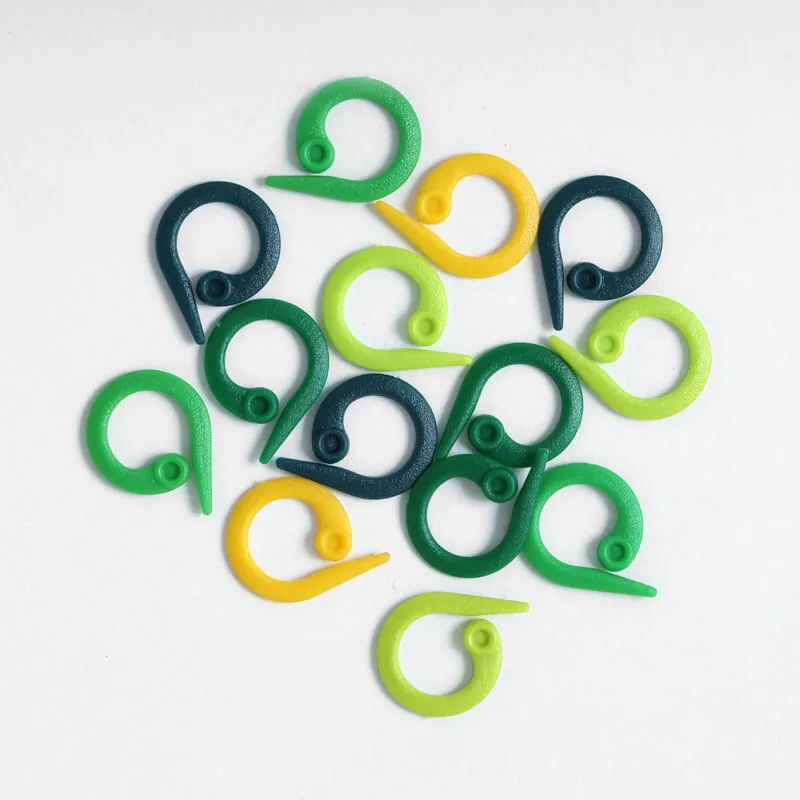 30 split-ring markers
30 MarkersPlenty for multi-point patterns
Split RingAdd or remove directly from a stitch
PlasticLightweight in your work
SKU 10898KnitPro MIO utility tools
Because the important place is not always between two stitches
Closed rings are excellent when a marker must stay on the needle. A split ring gives you another option: attach the marker to the fabric itself. That makes it particularly useful when you discover a place you want to mark after you have already knitted or crocheted past it.
Rotate the opening back through the stitch instead of sliding the marker along a needle or cutting it out of the work.
Mark the first stitch of a round or a counting point even when there is no knitting needle available to hold a closed ring.
Simple, fast and repositionable
A marker for places that may need to move
The split in the ring provides an entry path for the yarn stitch. You can attach the marker without opening a clasp, then remove or reposition it as the pattern progresses.
- Place directly through a knitted or crocheted stitch
- Hook onto a needle when a temporary on-needle marker suits the pattern
- Move the marker upward as rounds or rows progress
- Use different colours for different instructions or sections
The split-ring advantage
It marks the work itself
Open route in, central ring to holdGuide the marker through the stitch rather than pulling or stretching the yarn around it.
For longer-term security: choose a locking marker when the project will be carried around or the marker must resist working loose in handling.
Useful wherever a pattern says “mark”
Round beginnings
Move a split marker into the first stitch of each crochet round or use it as a removable round reference.
Increases & decreases
Identify the exact stitches or shaping areas that need an increase, decrease or later check.
Pattern repeats
Break lace, cable, colourwork or texture instructions into manageable visual sections.
Counting groups
Divide a long cast-on, blanket edge or large stitch count into smaller groups that are easier to verify.
Garment placement
Mark button, pocket, sleeve, side-seam or shaping positions before the next construction step.
Right-side reference
Attach one marker to the public side so reversible or textured fabric is easier to orient.
Fix-it-later points
Flag a loose stitch, mistake or area that needs duplicate stitch, repair or closer inspection.
Progress markers
Mark where you began a session to see how many rows or rounds you complete before stopping.
Split ring, closed ring or locking marker?
All three styles have a purpose. The best choice depends on whether the marker should sit on the needle, attach to a stitch or close securely around the work.
| Feature | Split Ring | Closed Ring | Locking |
|---|---|---|---|
| How it attaches | Rotates or hooks directly into a stitch; can also sit on a suitable needle | Slides onto the needle between stitches | Opens, passes through a stitch and clicks closed |
| Can be added after passing the position? | Yes | No—the marker must be on the needle | Yes |
| Can be removed without reaching the needle tip? | Yes | No | Yes |
| Speed | Very quick—no clasp to operate | Very quick when slipping between needles | Requires opening and closing |
| Security in transit | Good for temporary marking; check after heavy handling | Secure while it remains captured on the needle | Best choice when a removable marker must stay firmly closed |
| Best match | Temporary stitch marking, crochet, progress and placement points | Repeats, shaping sections and round beginnings in knitting | Longer-term stitch marking, crochet and projects carried in a bag |
How to attach and remove a split-ring marker
Choose the stitch
Identify the exact loop or space your pattern requires, checking whether the marker should sit in the stitch or between stitches.
Find the opening
Position the tapered open end beside the yarn loop. Do not pull the stitch wide or force a thick yarn into the split.
Rotate it through
Gently guide the marker through until the yarn rests in the central ring and the marker hangs freely.
Reverse to remove
When the reference point has served its purpose, rotate the split back through the stitch and return the marker to its pouch.
Good marker habits: the marker should not pull, spread or distort the stitch. If it feels cramped, choose a larger marker style or a locking marker better suited to the yarn.
KnitPro MIO 10898 at a glance
| Brand | KnitPro |
|---|---|
| Range | MIO utility tools |
| Product | Split ring stitch markers / open stitch markers |
| KnitPro SKU | 10898 |
| Pack quantity | 30 markers |
| Material | Plastic |
| Marker style | Removable open split-ring design |
| Colours | Assorted bright MIO shades; colours may vary |
| Packaging | Paper packaging |
| Crafts | Knitting and crochet |
| Typical uses | Pattern repeats, increases, decreases, rounds, stitch counting, placement and progress marking |
Not a stitch holder: these markers identify a place in the work. They are not designed to carry loose live stitches or replace waste yarn, a cable needle or a purpose-made stitch holder.
KnitPro MIO Split Ring Marker FAQs
What is included in KnitPro set 10898?
The pack contains 30 plastic MIO split-ring stitch markers in assorted bright colours.
What is a split-ring stitch marker?
It is an open removable marker with a split entry path. You can guide it directly into or out of a stitch without sliding it along the knitting needle.
Can these markers be used for crochet?
Yes. Because they attach directly to a stitch, they are useful for marking round beginnings, counting points, shaping and other reference positions in crochet.
Can they be used in knitting?
Yes. They can mark individual stitches, shaping points, progress, placements and mistakes, or hook onto a suitable needle when a temporary on-needle marker is useful.
What is the difference between split-ring and closed-ring markers?
A split ring can be added to or removed from the work at any time. A closed ring sits on the knitting needle and must be slipped from one needle to the other as you reach it.
What is the difference between split-ring and locking markers?
Both can attach directly to a stitch. A split ring is faster because there is no clasp, while a locking marker closes and is generally the better choice when the marker must remain secured through transport or repeated handling.
Can I add one after I have passed the stitch?
Yes. That is one of the main advantages of a split-ring marker: you can attach it to a stitch already in the fabric and remove it later.
Will they fit every knitting needle and yarn?
No universal fit is guaranteed. KnitPro does not publish a maximum needle size for 10898. The marker should move freely without stretching or distorting the stitch; use another size or style if it feels cramped.
Can I use them to hold dropped or live stitches?
They are intended as markers, not stitch holders. Use a purpose-made locking stitch marker, stitch holder or waste yarn when a live stitch needs to be secured.
Do the colours always match the photograph?
The markers are supplied in assorted bright MIO shades. Colour proportions can vary between production batches.
How should I store them?
Keep the markers together in a notions pouch or container away from young children and pets. Replace a marker if it becomes cracked, rough or misshapen.
Mark it now, move it later and keep the pattern on track
With 30 bright, removable split-ring markers ready to attach directly to knitting or crochet, KnitPro MIO 10898 is the simple way to stay oriented through every repeat, round and shaping step.
Review the Specifications