
Needle-Feed Control
The needle travels with the material during feeding, helping reduce movement between fabric layers and improve seam matching.
The JUKI DLN5410NDDJ7WBK/AK85B is a fully automatic, direct-drive industrial lockstitch machine configured for jeans, denim and other suitable heavy garment fabrics. Its needle-feed mechanism helps keep fabric layers aligned, while the double-capacity hook, automatic thread trimmer, reverse feed, thread wiper and AK85B automatic footlift support efficient production sewing.
Exact configuration: DLN5410NDDJ7WBK with AK85B automatic presser-foot lift.

This is not simply a standard plain sewer with a larger needle. The jeans-specification JUKI combines needle feeding, a longer needle-bar stroke, a large hook and automatic production functions in one purpose-built industrial workstation.
The needle travels with the material during feeding, helping reduce movement between fabric layers and improve seam matching.
The J configuration uses a 33 mm needle-bar stroke and is intended for denim, jeans production and suitable heavy garment fabrics.
The large bobbin carries more lower thread than a standard hook, reducing interruptions for bobbin replacement.
The compact servo motor connects directly to the main shaft for responsive starting, stopping and speed control.
Automatic thread trimming, reverse feed, thread wiping and presser-foot lifting reduce repeated manual actions.
JUKI’s low-tension sewing capability helps support smooth seam formation and reduced puckering across changing fabric conditions.
On a conventional bottom-feed lockstitch machine, the feed dog moves the fabric from underneath. On the DLN-5410NDDJ-7, the needle also moves in the feeding direction while it remains engaged with the material.
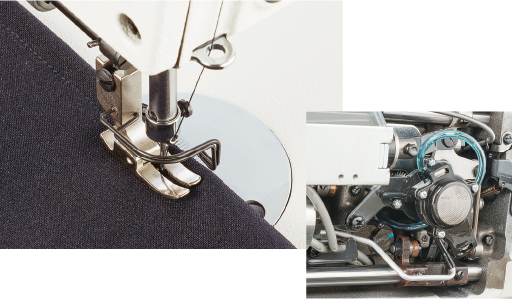
Key end-of-seam and material-handling tasks are built into this exact configuration.
Heavy-fabric and denim sewing often uses thicker thread, which consumes the available bobbin supply more quickly. The double-capacity hook provides more lower-thread capacity than a standard industrial lockstitch hook.
A larger bobbin does not make the machine sew heavier material by itself. Its advantage is increased lower-thread capacity, while the jeans specification and needle-feed system provide the heavy-fabric sewing capability.
The direct-drive motor and AK85B automatic presser lifter work with the automatic sewing functions to create an efficient industrial production cycle.
The compact servo motor is connected directly to the main shaft, removing the traditional external motor belt and improving response.
Electronic motor control provides responsive operation and allows the maximum sewing speed to be set for the process.
The automatic lifter raises the presser foot to approximately 9 mm, reducing repeated hand or knee operation when positioning and removing work.
The machine trims the needle and bobbin threads at the completion of the sewing cycle.
Programmable reverse stitching can secure the beginning and end of a seam with greater consistency.
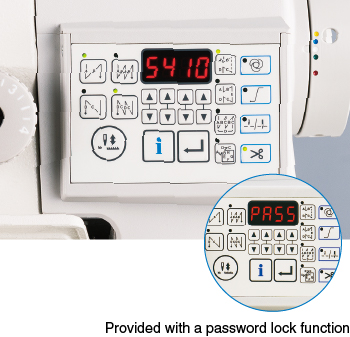
Sewing speed and production-support settings can be adjusted from the built-in control system, which also includes a password-lock function.
Material suitability depends on the fabric construction, number of layers, thread, needle, seam design and required sewing speed. Direct Sewing can help assess samples before purchase.
A needle-feed machine provides more material control than a standard bottom-feed plain sewer, but it is not the same as a compound-feed walking-foot machine.
| Machine type | How it feeds | Best suited to |
|---|---|---|
| Standard bottom feed | The feed dog moves the material from underneath. | General apparel and light-to-medium fabrics where ply movement is limited. |
| JUKI needle feed | The needle moves with the bottom feed while engaged in the material. | Denim, workwear, matched seams and suitable heavy woven garment fabrics. |
| Compound walking foot | The needle, feed dog and alternating walking feet work together. | Bulky assemblies, upholstery, thick leather, foam-backed materials and challenging multi-layer work. |
Bring or send Direct Sewing a sample of the material, thread and seam construction. The team can help determine whether this needle-feed model or a compound-feed walking-foot machine is the better choice.
| Complete model | DLN5410NDDJ7WBK/AK85B |
|---|---|
| Machine type | Direct-drive, single-needle, needle-feed lockstitch machine with automatic thread trimmer |
| Application | Jeans, denim and suitable heavy garment fabrics |
| Maximum sewing speed | Up to 4,000 stitches per minute |
| Maximum stitch length | 4.5 mm |
| Needle-bar stroke | 33 mm |
| Needle-feed adjustment | Approximately ±15% |
| Needle system | DB × 1, sizes #20–#23; standard specification #21 |
| Hook | Automatic-lubricating, double-capacity full-rotary hook |
| Presser-foot lift | 5.5 mm by hand; approximately 9 mm with AK85B automatic footlift |
| Automatic functions | Thread trimming, reverse feed, thread wiping and presser-foot lifting |
| Lubrication | Automatic |
| Recommended oil | JUKI Machine Oil 7 or equivalent ISO VG7 sewing-machine oil |
| Power requirement | Single-phase 220–240 V |
| Rated power consumption | 390 VA |
| Machine-head weight | Approximately 36 kg, including motor, control box and covers |
Specifications are based on JUKI information for the DLN-5410NDDJ-7 configuration. Material suitability and production speed depend on the fabric, seam, thread and needle combination.
Direct Sewing supplies, sets up and supports industrial sewing equipment for New Zealand manufacturers, workrooms, alteration businesses and apparel producers.
Correct machine selection depends on more than fabric weight. Our team can consider the material, number of layers, seam construction, thread size and expected production volume before recommending a setup.
Visit: 138 Railside Avenue, Henderson, Auckland
Phone: (09) 838 8674
Mobile: 021 274 2910
Email: info@directsewing.co.nz
It is a direct-drive, single-needle, needle-feed industrial lockstitch machine with a large bobbin and automatic production functions. The J specification is intended for jeans, denim and suitable heavy garment fabrics.
Needle feed means the needle moves in the feeding direction while it remains engaged with the fabric. Working with the bottom feed, this helps reduce slipping between layers and improve material control.
Yes. This is the jeans specification with a 33 mm needle-bar stroke, heavy-size DB × 1 needles and a double-capacity hook. It is suited to denim and other appropriate heavy woven garment fabrics.
No. This machine combines needle feed with bottom feed. A compound-feed walking-foot machine also uses alternating presser feet and is generally better for bulky upholstery, thick leather, foam-backed materials and challenging layered assemblies.
The double-capacity hook carries more lower thread than a standard industrial lockstitch bobbin. This reduces the frequency of bobbin changes, particularly when using heavier thread or sewing long production seams.
This configuration includes automatic thread trimming, automatic reverse-feed stitching, a thread wiper and the AK85B automatic presser-foot lift.
The AK85B automatically raises the presser foot at the required stage of the sewing cycle. Its standard lifting amount is approximately 9 mm, reducing repeated manual foot-lifting movements.
The servo motor connects directly to the machine’s main shaft. This provides responsive operation, electronic speed control, lower power use and less belt-related maintenance than a traditional external clutch-motor arrangement.
The maximum rated sewing speed for the heavy and jeans configuration is up to 4,000 stitches per minute. The operating speed should be set according to the material, thread, needle and sewing process.
It uses the DB × 1 industrial needle system, with sizes #20–#23 specified for the heavy and jeans configuration. The standard specification is #21. Direct Sewing stocks SCHMETZ DB × 1 needles .
The maximum stitch length for the heavy and jeans specification is 4.5 mm.
The JUKI specification lists single-phase 220–240 V power and rated consumption of 390 VA. Site power and plug requirements should be confirmed with Direct Sewing before installation.
Yes. Contact Direct Sewing with details or samples of the material, seam, thread and number of layers. The team can help compare this needle-feed machine with other heavy-fabric and walking-foot options.
Yes. Direct Sewing provides local operating guidance, servicing and after-sales technical support from its Auckland showroom and workshop.
Talk with Direct Sewing about your material, thread, seam construction and production requirements. We can help confirm whether the DLN5410NDDJ7WBK/AK85B is the right needle-feed machine for your work.