


One-push air threading
Thread the upper and lower loopers with a controlled blast of air instead of guiding thread manually through multiple points.
Professional overlocking becomes easier when threading no longer stands in the way. The Janome AirThread 2000D Professional combines one-push air threading, a built-in needle threader, eight-piece feed system, differential feed and 2, 3 or 4-thread versatility in an award-winning premium overlocker.
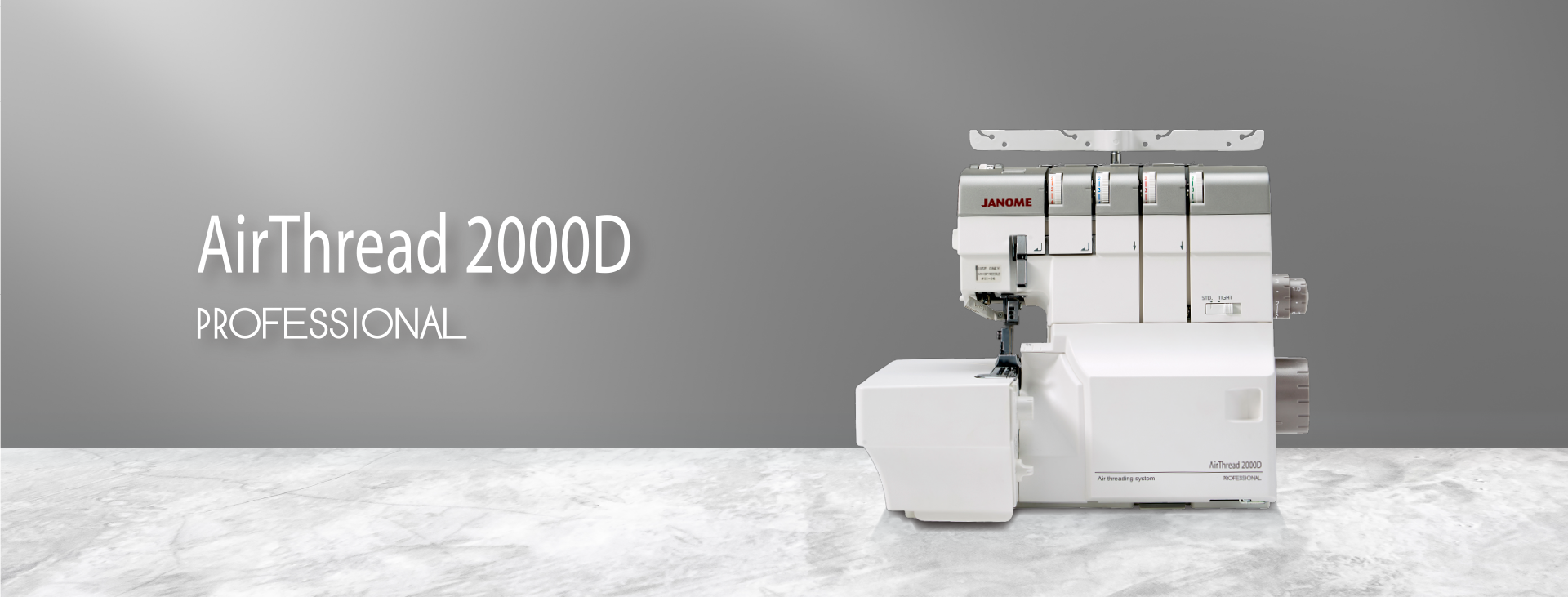
The AirThread 2000D Professional is built for garment makers, stretch-fabric sewists, alteration specialists and creative studios that want fast, polished seam finishing with a simpler threading process.
Insert each looper thread into its threading port, select the upper or lower looper and press the air-threading lever. A controlled burst of air carries the thread through the internal channel and out through the looper eye.
The needles are handled separately using the built-in needle threader, which slides between the left and right needle positions.
Once threaded, the machine can create strong four-thread seams, neat three-thread edge finishes, fine two-thread overcasting, rolled hems, picot edges, flatlocking and decorative stretch finishes.
The standard package includes the waste collector, foot controller, protective cover, spare upper knife, looper-threading wire, needles, tools and cleaning accessories.
Thread the upper and lower loopers with a controlled blast of air instead of guiding thread manually through multiple points.
Slide the selector to the left or right needle position and use the integrated threader to draw thread through the needle eye.
Strategically positioned feed sections maintain broad contact with fine knits, woven fabrics and layered projects.
Configure the machine for construction seams, edge finishing, lightweight overcasting, rolled hems and flatlocking.
Swing the integrated converter into position without fitting or storing a separate removable component.
Adjust fabric movement from 0.5 to 2.0 to control stretching, puckering, gathering and decorative effects.
Adapt the pressure applied to lightweight, stretch, standard woven and thicker fabrics.
The machine will only operate when the looper cover, side cover and presser-foot safety systems are correctly engaged.
The ratchet-style air delivery mechanism produces a controlled blast through the internal looper-threading channel.
Insert a short thread tail into the selected port, move the looper selector to the upper or lower position and press the threading lever.
The thread travels through the enclosed channel and emerges through the looper eye, greatly reducing the most complicated part of overlocker threading.
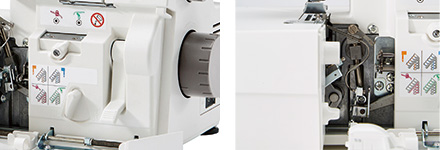
The air-threading system is intended for standard overlocker threads. Very thick, textured or speciality threads may need to be pulled through using the supplied looper-threading wire or a standard leader thread.
The threading wire is included so speciality threads can still be used when they are not suitable for direct air threading.
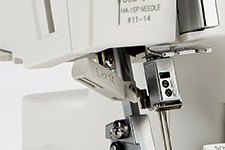
Move the needle-threader selector towards the left or right position depending on the needle being used.
Lower the mechanism, place the thread into the guide and allow the threader to draw a loop through the needle eye.
This removes much of the close-up manual work normally required when threading overlocker needles.
The feed system uses eight strategically placed sections to maintain contact with the underside of the fabric before, beneath and after the presser foot.
Grooves beneath the standard foot further support smooth movement through slippery, stretch and challenging fabrics.
The result is stronger control when overlocking fine knits, jersey, cotton, denim, fleece and layered garment sections.
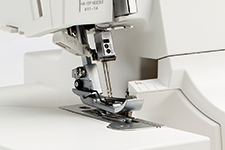
The differential-feed control changes the relationship between the front and rear feed dogs.
Reduce the setting when a fabric needs to be stretched slightly, or increase it to prevent knit edges from waving and lightweight woven fabrics from puckering.
Higher settings can also create controlled gathering and decorative lettuce-leaf effects.
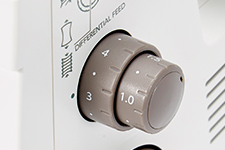
Increase differential feed when knit edges stretch while being overlocked.
Adjust the feed relationship when fine woven fabrics gather unintentionally.
Use a higher setting with suitable stitch length and tension for controlled gathering.
Stretch suitable knit fabric while sewing a rolled hem to create a decorative wave.
Use differential feed to ease one fabric edge into another during garment construction.
Return to the normal setting when no stretch or gathering correction is needed.
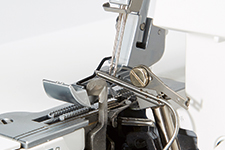
Two-thread overlocking normally requires a small converter to close the upper looper.
On the AirThread 2000D, the converter is permanently built into the mechanism. Lift it into place when required and return it to its storage position when switching back to three or four threads.
Two-thread stitches reduce bulk and thread consumption, making them useful for lightweight fabrics, delicate edges and decorative flatlocking.
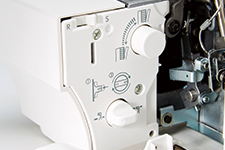
The key fine-adjustment controls are located on the right side of the sewing bed rather than being hidden deep inside the machine.
Adjust the cutting width to match the fabric thickness and stitch formation, disengage the upper knife when trimming is not required and move the stitch finger for rolled-hemming techniques.
Raise the presser foot to release the tension discs and lay each thread into its colour-coded guide.
The slide-in design helps ensure that threads enter the tension system correctly without needing to be pulled through narrow slots.
Each threading route is colour coded and supported by a diagram inside the machine.
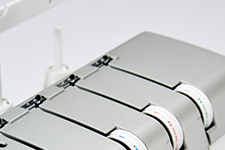
Each needle and looper thread has its own numbered tension control.
Recommended starting settings are shown in the instruction guide, after which each thread can be adjusted to balance the stitch for different fabrics, threads and techniques.
The AirThread 2000D does not have automatic thread tension. Air threading simplifies the looper-threading process, while stitch balance remains manually adjustable through the four tension dials.
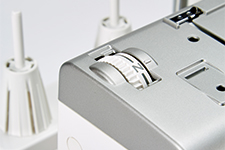
Use the normal setting for most everyday overlocking, then reduce or increase pressure when a fabric requires different handling.
Lower pressure can help prevent lightweight or stretch fabric from being distorted, while additional pressure can improve contact on firmer materials.
Pressure may also need to be adjusted when fitting certain optional specialist feet.
The sewing bed provides approximately 118mm of space in front of the needle, 142mm behind it and an overall depth of approximately 248mm.
The broad surface helps support garments, quilts, activewear, home décor and larger fabric sections as they approach and leave the cutting and stitching area.
The low-profile waste collector clips beneath the looper cover without creating a bulky obstruction in front of the machine.
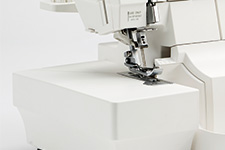
The machine checks the side cover, looper cover and presser-foot position before allowing the motor to operate.
If one of the monitored areas is open or incorrectly positioned, the machine will not begin sewing.
This is especially important on an overlocker because the upper knife, lower knife, loopers and needles operate close together at high speed.
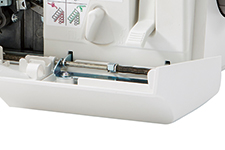
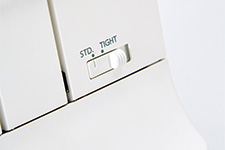
The lower-looper pre-tension slider provides a quick way to alter the thread path for different overlock and rolled-hem configurations.
Use the standard position for ordinary overlocking and the tighter position when directed by the stitch settings in the instruction manual.
The control reduces the amount of tension-dial adjustment required when moving between selected techniques.
A strong, stretchable construction seam for knit garments and general overlocking.
Edge finishing and construction using the left needle for a wider stitch.
A narrower edge finish using the right needle for lighter and medium-weight fabrics.
A light, flat edge finish that reduces thread bulk on delicate materials.
A compact rolled edge for scarves, napkins, ruffles and lightweight hems.
An especially fine rolled finish for chiffon, bridal fabrics and delicate edges.
A softly scalloped finish for chiffon, georgette, fine knits and sheer fabrics.
A flat joining or decorative technique suitable for fleece, knits, activewear and lingerie.
A decorative wavy rolled hem created by combining stretch fabric with differential feed.
The AirThread 2000D is an overlocker. It trims the fabric edge and forms overlock stitches, but it does not replace a conventional sewing machine for straight stitching, buttonholes, zip insertion or topstitching.
It does not create a coverstitch or top-and-bottom cover seam. A separate coverstitch machine is required for professional twin-needle-style knit hems.
The machine has manual tension dials. The air system threads the upper and lower loopers but does not automatically adjust thread tension.
It is a premium domestic overlocker rather than a continuous-production industrial overlocking machine.
| Machine type | Premium domestic air-threading overlocker |
|---|---|
| Thread configurations | Two, three or four threads |
| Needle configurations | One or two needles |
| Looper threading | One-push air threading for the upper and lower loopers |
| Needle threading | Built-in threader selectable for the left or right needle |
| Maximum sewing speed | Up to 1,300 stitches per minute |
| Feed system | Eight-piece feed dog system |
| Differential feed | Adjustable from 0.5 to 2.0 |
| Stitch length | Adjustable from 1.0 to 5.0mm |
| Standard stitch length | Approximately 3mm |
| Cutting width using left needle | Approximately 5.5 to 7.5mm |
| Cutting width without left needle | Approximately 3.3 to 5.3mm |
| Thread tension | Four manually adjustable tension dials |
| Upper-thread guides | Colour-coded slide-in lay-in threading |
| Lower-looper pre-tension | Standard and tight slider settings |
| Two-thread converter | Built-in one-step converter |
| Presser-foot pressure | Five manually adjustable levels |
| Presser-foot attachment | Snap-on |
| Upper knife | Easily retractable using a dedicated release control |
| Rolled-hem conversion | Quick-change stitch-finger control without changing the needle plate |
| Safety system | Three microswitches monitoring the covers and presser-foot system |
| Workspace in front of needle | Approximately 118mm |
| Workspace behind needle | Approximately 142mm |
| Sewing-bed depth | Approximately 248mm |
| Lighting | White LED sewing light |
| Waste collector | Low-profile waste chip box included |
| Foot controller | Included |
| Machine dimensions | Approximately 347mm wide × 299mm high × 284mm deep, including the handwheel |
| Machine weight | Approximately 7.7kg |
| Main shaft | Dual ball-bearing construction for stability and durability |
| Coverstitch capability | No |
| Machine cover | Protective dust cover included |
Read the complete guide covering air threading, needle threading, stitch settings, tension and maintenance.
View Janome Australia’s regional overview of the air-threading system and fabric-handling features.
Explore the air threading, feed system, needle threader, controls, workspace and standard accessories.
View stitch specifications, optional accessories, machine information and official Janome resources.
The air system threads the upper and lower loopers. The left and right needles are threaded using the machine’s separate built-in needle threader.
No. The machine has four manual tension dials, allowing each needle and looper thread to be adjusted individually.
Yes. The AirThread 2000D can be configured for two-thread, three-thread and four-thread overlocking.
Yes. The converter is attached to the upper-looper mechanism and swings into position when required.
Yes. The stitch finger can be moved into the rolled-hem position without changing the needle plate.
No. It is an overlocker and does not create a coverstitch. A dedicated coverstitch machine is required for professional knit hems with parallel stitching on top.
Differential feed helps prevent waving on knits and puckering on lightweight fabrics. It can also create gathers and decorative stretched edges.
Stitch length and differential feed can be adjusted using the external dials. Changes should always be made carefully while maintaining control of the project.
Yes. The upper knife can be retracted when fabric trimming is not required.
Yes. The pressure dial provides five levels for adapting the machine to different fabrics and optional feet.
Yes, although very thick or textured thread may not pass directly through the air system. The supplied threading wire or a standard leader thread can be used instead.
Yes. A low-profile waste chip box is included to collect trimmed fabric edges.
The AirThread 2000D can sew at up to 1,300 stitches per minute.
Yes. Air threading and the built-in needle threader remove two of the most intimidating parts of setting up an overlocker. Users still need to learn tension, differential feed and cutting-width adjustment.
No. It is a premium domestic overlocker designed for regular garment and creative sewing rather than continuous industrial production.
Direct Sewing has supplied sewing, quilting, embroidery and overlocking equipment throughout New Zealand since 2001. Our experienced team can demonstrate the AirThread 2000D and explain air threading, tension balance, differential feed, cutting width, rolled hems and optional feet.
With genuine product knowledge, nationwide support and an in-house technical workshop, you can purchase with confidence and continue receiving assistance long after your machine leaves our showroom.
For sewists who want fast professional seam finishing with one of Janome’s easiest threading systems, the AirThread 2000D Professional is an outstanding premium overlocker.