
Denim alterations
Jeans hems, repairs, waist and leg alterations using the correct needle, thread and seam preparation.
The stronger member of Singer's 142G direct-drive family is built for sewing rooms that regularly move beyond shirting into trousers, garment denim, uniforms, workwear and heavier homewares. Its longer 7mm stitch, #18 standard needle setup and 35mm needle-bar stroke give medium-to-heavy work the right foundation—without sacrificing quiet servo control.
 142G-30CEA · medium-to-heavy
Singer's -30 subclass has a longer needle-bar stroke, higher standard needle size and longer stitch than the lighter 142G-20CEA. Those changes make it a better fit for heavier garment fabrics, denim alterations, workwear and sturdier sewn products.
It remains a bottom-feed straight-lockstitch machine. For slippery multi-layer assemblies, upholstery, thick leather or webbing, a needle-feed or compound walking-foot machine may still be the correct choice.
Controlled power for substantial seam stacks
Jeans hems, repairs, waist and leg alterations using the correct needle, thread and seam preparation.
Overalls, uniforms, work trousers and many medium-to-heavy woven garment operations.
Long straight seams, topstitching and construction in suitable suiting and heavier apparel fabrics.
Tote bags, aprons, pouches and selected light-to-medium canvas projects after sample testing.
Cushions, heavier curtains, covers and decorative projects within a bottom-feed machine's limits.
A stronger everyday plain sewer for businesses that see varied garments and frequent denim work.
Repeat medium-to-heavy straight seams with a stable table and speed suited to professional workflows.
Develop workwear, bags and heavier apparel without stepping immediately into an automated machine.
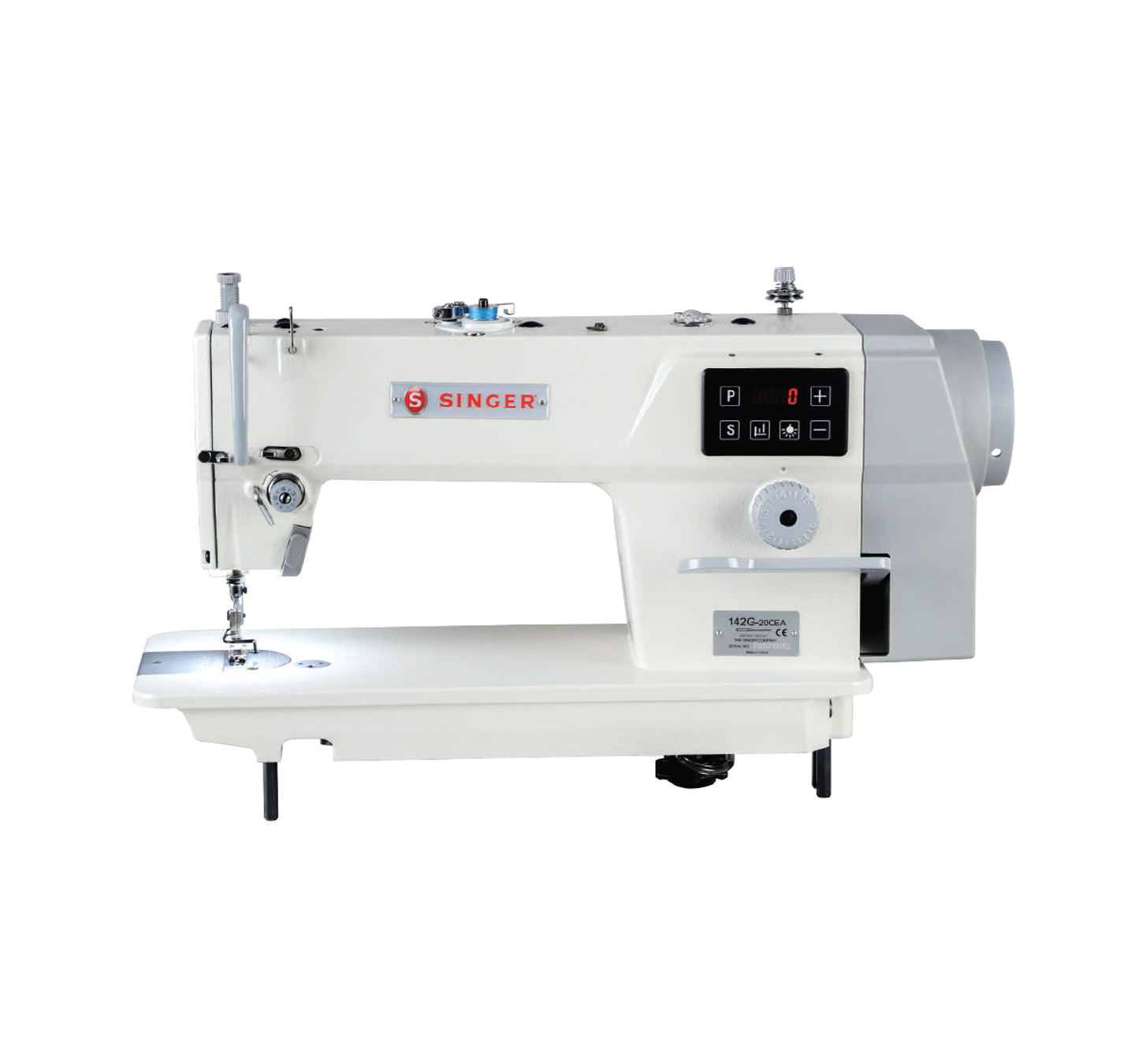
The integrated 550W servo motor transfers power directly into the machine head. It is quiet while waiting and responsive when the operator presses the pedal, without the continuous hum and free-running speed of an older clutch motor.
Select the stop position for turning corners, repositioning a bulky piece or removing finished work.
Limit top speed in 100-stitch increments from the integrated panel to suit the operation and operator.
Choose stronger or softer illumination at the needle area, or switch the light off when not needed.
Control backtacks directly at the machine to secure seam beginnings and endings.
Configure the hand switch for half-stitch, single-stitch or combined positioning control.
Wind the next standard bobbin at the workstation without a separate machine.
The oil-pump system distributes lubricant through the high-speed mechanism during operation.
Raise the presser foot while keeping both hands available to position heavier work accurately.
The integrated control system includes protective and self-checking functions for the motor electronics.
Direct Sewing supplies the Singer 142G-30CEA built into its industrial table and stand, giving the machine and heavier projects the stability they need.
| Feature | 142G-20CEA | 142G-30CEA this machine |
Compound / walking-foot machine |
|---|---|---|---|
| Best suited to | Light-to-medium garment and general sewing | Medium-to-heavy garments, denim, workwear and sturdier general sewing | Bulky layered assemblies, upholstery, leather, webbing and difficult layer matching |
| Feed system | Bottom drop feed | Bottom drop feed | Alternating presser feet, usually with needle feed |
| Maximum speed | 5,000 sti/min | 4,000 sti/min | Usually slower; model dependent |
| Maximum stitch length | 5mm | 7mm | Model dependent; often longer |
| Standard needle | Singer #14 | Singer #18 | System and size depend on model |
| Needle-bar stroke | 30.7mm | 35mm | Model dependent |
| Strongest reason to choose | Maximum speed and finesse on lighter work | A stronger plain sewer that remains fast, simple and excellent value | Positive control of layers that bottom feed alone may not move evenly |
| Model | Singer 142G-30CEA |
|---|---|
| Series | 142G E-series |
| Machine type | Industrial single-needle, bottom-feed, straight-lockstitch sewing machine |
| Official material application | Medium-to-heavy materials |
| Maximum sewing speed | Up to 4,000 stitches per minute |
| Maximum stitch length | 7mm |
| Presser-foot lift | 6mm by hand; up to 13mm by knee |
| Needle-bar stroke | 35mm |
| Feed system | Bottom drop feed |
| Hook | Standard rotary hook |
| Needle system | Singer 1955-01 / DP × 5 / 135 × 5 / 16 × 231 |
| Standard Singer needle size | #18 for the medium-to-heavy subclass; match the actual size and point to the material and thread |
| Drive | Integrated energy-saving direct-drive servo motor |
| Motor output | 550W |
| Needle positioning | Needle up/down selectable from the integrated operation panel |
| Speed setting | Adjustable maximum sewing speed |
| Reverse | Manual reverse/backtack lever |
| Thread trimming | Manual; the CEA E-series model does not have an automatic under-bed trimmer |
| Lubrication | Fully automatic oil-pump lubrication |
| Lighting | Integrated LED light with two brightness levels |
| Bobbin winding | Built-in bobbin winder |
| Power specification | AC 220V ±20%, 50/60Hz factory specification |
| Warranty | 1-year return-to-base warranty under Direct Sewing's current listed terms |
It is a full-size industrial single-needle straight-lockstitch machine with bottom feed and an integrated direct-drive servo motor, configured by Singer for medium-to-heavy materials.
The official Singer specification is 7mm. This gives the -30 subclass more flexibility for topstitching and substantial materials than the 5mm maximum of the 142G-20CEA.
Up to 4,000 stitches per minute. The integrated panel lets the operator set a lower maximum for learning, bulky intersections or detailed work.
It describes Singer's factory configuration: a longer needle-bar stroke, #18 standard needle and 7mm stitch for more substantial garment and general-sewing materials. Suitability still depends on the exact material, layers, coating, thread and seam construction.
Yes, it is a strong choice for many garment-denim and jeans alteration operations. Use the correct needle and thread, reduce speed at bulky crossings and test unusually thick seam stacks.
It can handle selected canvas work within its needle, feed and lift capacity. Thick coated canvas, many layers, binding assemblies or bulky seams may require needle feed or compound feed, so test a representative sample first.
It is not designed as a leather walking-foot machine. Some light, stable leather may sew with specialised setup, but regular leather goods, upholstery leather and slippery layered work generally need a more appropriate feed system.
Not as a general upholstery recommendation. Foam-backed fabrics, piping, vinyl and layered upholstery assemblies are usually better handled by a compound-feed walking-foot machine.
No. It uses bottom drop feed. The presser foot holds the work while the feed dog advances it from underneath.
The -30 is the stronger medium-to-heavy subclass. It has a 35mm needle-bar stroke, 7mm maximum stitch and #18 standard needle, while the faster -20 is configured for light-to-medium work with a 30.7mm stroke, 5mm stitch and #14 standard needle.
The -30 mechanism is configured for more substantial material and a longer stitch rather than the highest possible garment-sewing speed. Its 4,000-stitch maximum remains very fast for industrial production.
The servo motor is integrated with the machine head, providing responsive pedal control without a separate under-table clutch motor or long drive belt. It remains quiet when the machine is idle.
Yes. Set a lower maximum speed from the front panel, which is useful for learners, short operations and bulky seam crossings.
The stop position is selectable. Needle-down is useful for turning and repositioning; needle-up can make removing completed work more convenient.
No. Automatic trimming belongs to Singer's CF-series variants, not this 142G-30CEA E-series model. Needle and bobbin threads are trimmed manually.
No. Use the reverse lever beside the needle area to sew securing stitches at the beginning and end of the seam.
No. The presser foot is raised by hand or with the knee lift. The knee lift reaches up to 13mm and keeps both hands available for positioning the project.
The compatible industrial system is Singer 1955-01, commonly cross-referenced as DP × 5, 135 × 5 or 16 × 231. Singer specifies #18 as the standard size for this subclass, but the actual point and size must match the material and thread.
No. Singer specifies a standard rotary hook. Do not assume “heavy” means a large bobbin or walking-foot hook system.
Yes. Direct Sewing's current package is supplied built into an industrial table and stand with the integrated motor, thread stand, treadle, knee lift and mobility wheels.
No. It is a full industrial workstation requiring permanent floor space. The wheels help move it within a room but it is not a portable machine for classes or travel.
Yes. It has an automatic oil-pump lubrication system, but the correct oil must be added and its level maintained. Follow the manual and Direct Sewing's setup instructions.
Yes, with instruction and a conservative speed limit. Start slowly and learn safe threading, bobbin, knee-lift, reverse and pedal operation before increasing speed or tackling bulky work.
The current Direct Sewing listing includes a one-year return-to-base warranty. Contact the team if you need clarification about coverage, freight or service arrangements.
The complete workstation requires freight. Contact Direct Sewing with the delivery address so the team can confirm the current method and cost.
Yes—contact Direct Sewing to arrange a showroom demonstration and bring the actual material, thread and thickest seam assembly. This is the best way to confirm whether bottom feed is suitable.
The Singer 142G-30CEA combines a stronger medium-to-heavy setup, quiet direct drive and straightforward operator control in a stable, complete industrial workstation.