
Chain stitch
A flexible single-needle stitch for seams, basting, decorative work and selected construction techniques.
Create professional stretch hems, bindings, necklines and decorative top-cover stitching at home. The Brother CV3550 combines chain stitch, narrow and wide coverstitch, triple coverstitch and genuine double-sided top-cover finishes in one compact specialist machine.
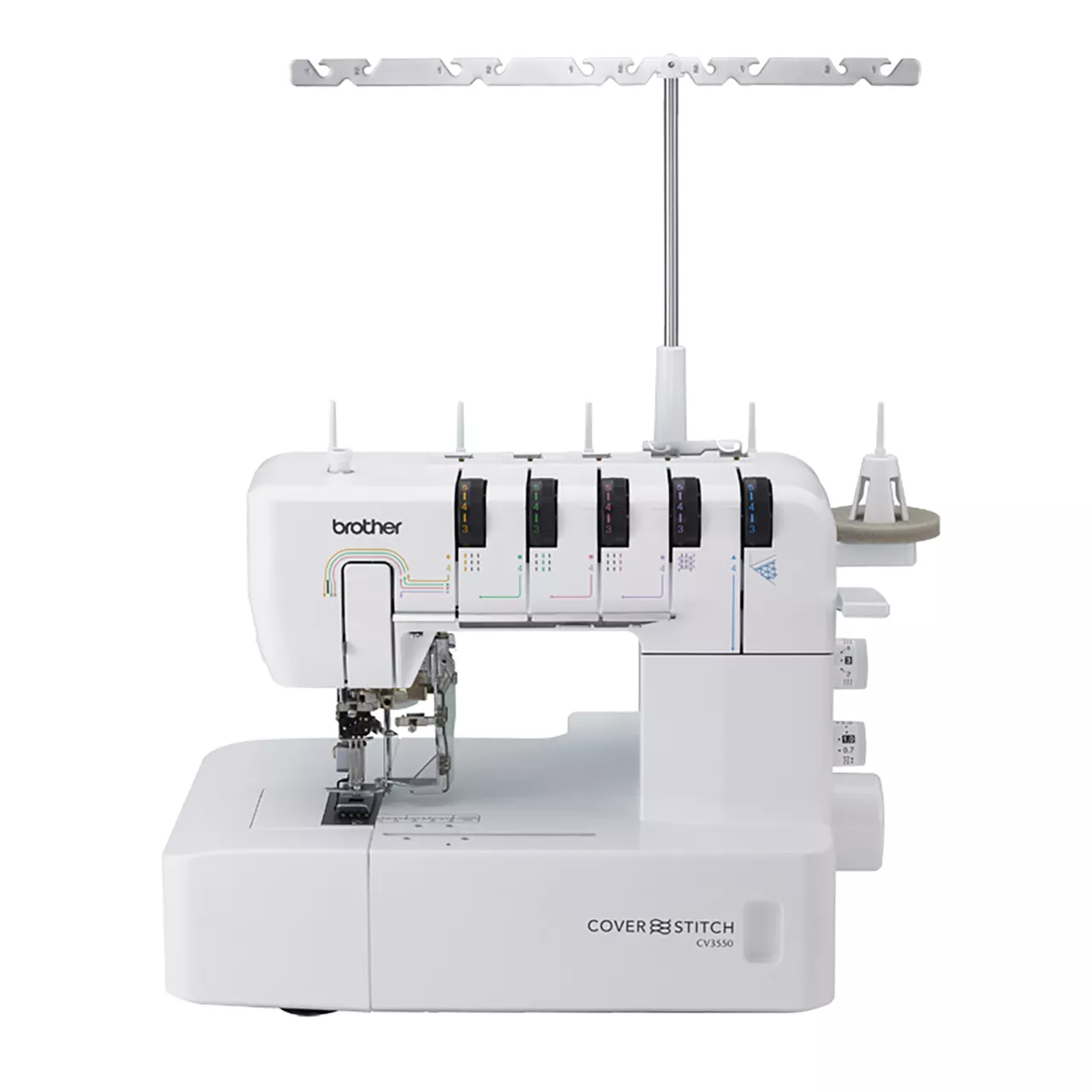
The Brother CV3550 is designed for the finishing work normally seen along T-shirt hems, activewear seams, knitwear necklines and professionally bound edges.
Unlike an ordinary sewing machine, its multiple needles and lower looper form flexible stitches that can stretch with knit and performance fabrics.
The upper cover spreader adds decorative thread across the visible side of the fabric, allowing top-cover finishes to be completed in the same operation.
It is an excellent partner to an ordinary sewing machine and overlocker for sewists making garments, sportswear, dancewear, children’s clothing and knit projects.
The CV3550 does not cut fabric and does not overlock raw seam allowances.
It is designed primarily for hemming, top stitching, decorative cover stitching, chain stitching and attaching suitable bindings.
Most garment makers use a sewing machine for construction, an overlocker for seam finishing and a coverstitch machine for professional stretch hems.
Standard coverstitch machines create parallel needle lines on top of the fabric and looper coverage underneath.
The CV3550 can also place an additional decorative cover thread across the top surface through its upper cover spreader.
This produces a distinctive finish on both sides of the fabric in one sewing operation.

A flexible single-needle stitch for seams, basting, decorative work and selected construction techniques.
Two closely spaced needle lines with looper coverage beneath for compact hems and top stitching.
Two wider-spaced needle lines for classic T-shirt hems and visible garment finishing.
Three parallel needle lines with broad looper coverage underneath for a strong decorative finish.
A two-needle narrow coverstitch with additional decorative thread across the fabric surface.
A wider two-needle top-cover finish for sportswear, decorative panels and standout hems.
Three needle lines combined with upper and lower cover threads for the fullest double-sided finish.
Add an upper cover thread for decorative stitching on both fabric surfaces.
Configure one, two or three needles for chain, narrow, wide and triple stitches.
Adjust fabric feeding to reduce stretching, rippling or unwanted gathering.
Gain useful room around the needles for hems, decorative panels and larger projects.
Remove the flatbed section for easier cuffs, sleeves, children’s garments and necklines.
Raising the presser foot releases the thread tension for easier project removal.
Disengage the lower looper and follow the colour-coded guides when threading.
Match presser-foot pressure to fine, stretchy, stable or layered materials.
Three needle threads, one lower-looper thread and one upper-cover thread.
The number of active threads depends on the stitch selected.
Chain stitch requires one needle and the lower looper, while ordinary coverstitches use two or three needles with the lower looper.
Top-cover configurations add the upper cover spreader thread to create the visible surface decoration.
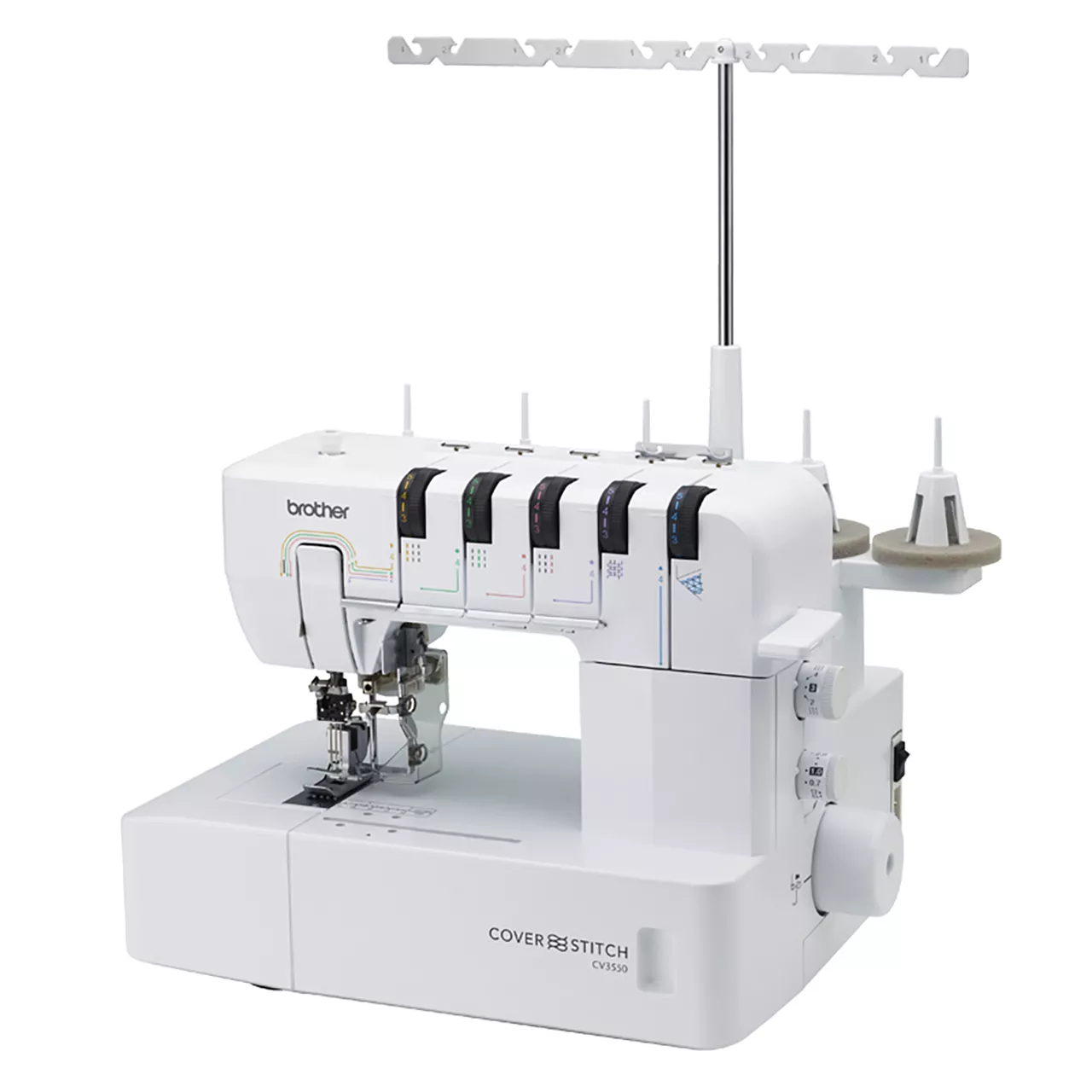
The generous flatbed provides useful room when hemming garments, stitching decorative panels or guiding wider projects.
Measurement markings around the needle area provide a visual reference while positioning hems and stitch lines.
The larger working area is particularly useful when coverstitch is being used decoratively away from the fabric edge.
Knit fabrics can stretch as they pass beneath the presser foot, producing a waved or flared hem.
Differential feed changes the relationship between the front and rear feed dogs to help the fabric remain flatter.
It can also be adjusted intentionally to create selected gathering or stretching effects.

Presser-foot pressure affects how firmly the fabric is held against the feed dogs.
Reduce pressure for selected fine, soft or easily stretched materials and increase it when firmer control is required.
Correct pressure works together with differential feed, thread tension and stitch length to improve the finished coverstitch.

Remove the flatbed section to expose the free arm and slide smaller tubular items around the machine bed.
This makes it easier to reach cuffs, narrow sleeves, children’s clothing, necklines and selected trouser hems.
The needles enter the fabric vertically rather than using the angled movement found on some overlocker-style platforms.
This direct action supports stable needle penetration and is useful when crossing ordinary garment seams and layered hems.
Correct coverstitch needles must still be fitted and replaced regularly for reliable results.
Each thread path is marked in a separate colour, helping identify the three needle threads, lower-looper thread and top-cover thread.
The telescopic metal thread stand keeps the threads elevated and separated as they feed toward the tension controls.
Thread nets and spool supports help manage slippery embroidery, overlocking and specialist threads.
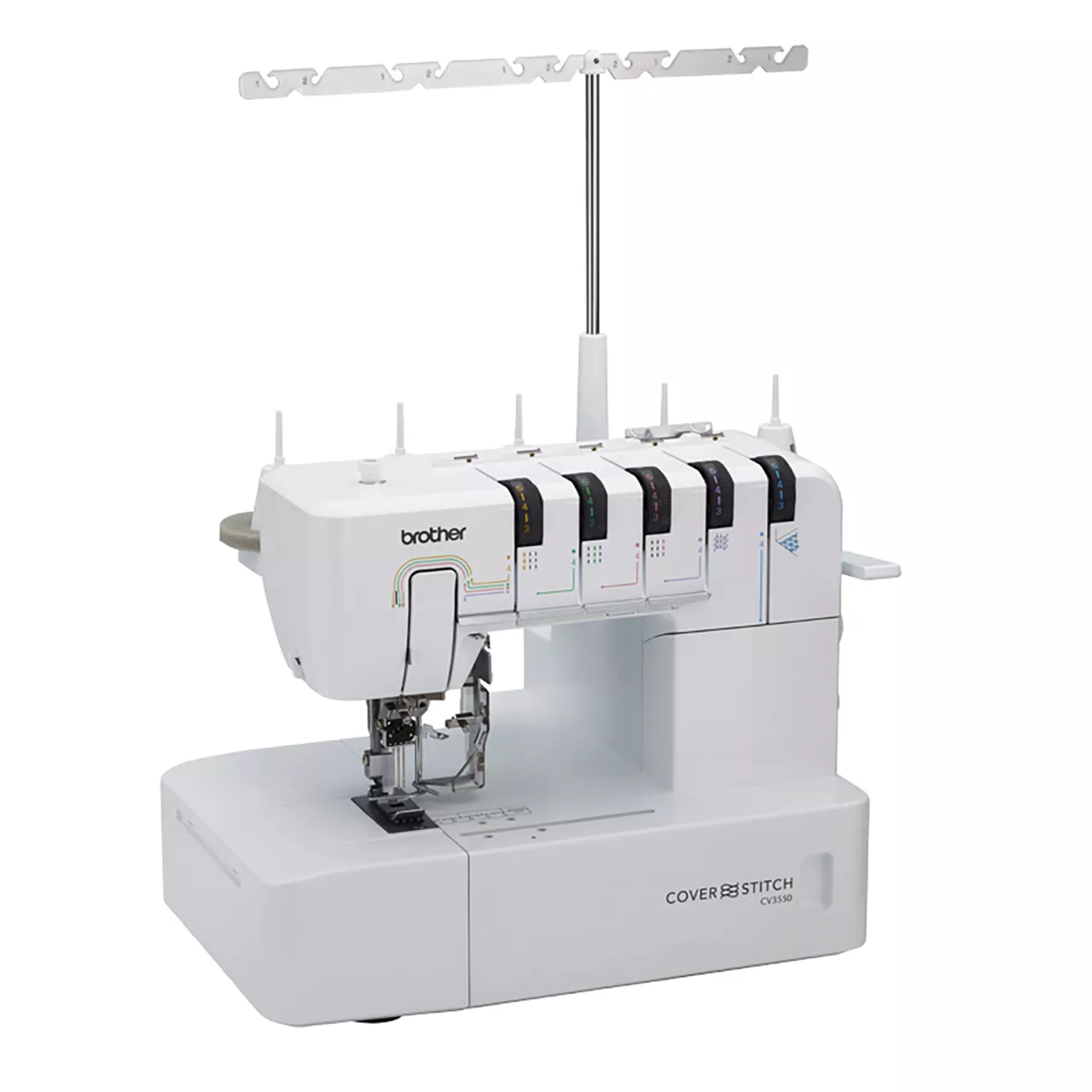
The lower looper can be released and brought into an accessible position for threading.
Follow the colour-coded guide, pass the thread through the required points and return the looper to its sewing position.
This is easier than reaching deep behind a permanently fixed looper mechanism.
Lifting the presser foot automatically releases the tension discs.
This allows the thread tails and completed project to be drawn away from the machine more easily.
Each thread tension remains independently adjustable so the stitch can be balanced for the selected fabric, thread and configuration.
Efficient coverstitch finishing for garments, activewear and repeated hemming.
Sewing speeds up to approximately 1,000 stitches per minute help complete T-shirt hems, leggings and longer garment edges efficiently.
Speed is controlled using the supplied electronic foot controller.
Slower operation remains useful when approaching seam intersections, beginning a circular hem or guiding difficult curves.
Use the right-side stitch-length dial to change how closely the stitches are formed.
Shorter settings create a denser appearance, while longer stitches can provide a more open decorative finish.
The best setting depends on fabric weight, stretch, thread type and intended use.
Brother offers compatible attachments that can help fold and guide fabric for repeated hems, bindings and belt loops.
These are particularly useful for necklines, armholes, activewear edges and garment makers who frequently repeat the same finish.
Attachment suitability depends on the finished binding width, fabric thickness and folding method required.

The integrated LED light illuminates the needle area and fabric markings.
Better visibility helps when aligning folded hems, changing needles, threading the upper spreader and approaching seam intersections.
The CV3550 includes a convenient built-in manual thread cutter for trimming thread tails.
It does not have an automatic electronic cutter, and it does not cut fabric while sewing.
Coverstitch is most commonly associated with jersey, Lycra, interlock, ribbing, fleece and other knit fabrics.
The CV3550 can also create chain and decorative cover stitches on many stable woven materials when correctly adjusted.
Test the complete stitch setup on a folded offcut from the project before sewing the finished garment.
Coverstitch does not generally secure itself in exactly the same way as a conventional lockstitch.
Thread tails should be handled correctly at the beginning and end of the seam, particularly on circular hems.
Depending on the project, the threads can be pulled to the underside and tied, secured through overlapping, or finished using an appropriate coverstitch technique.
The Brother CV3550 is a dedicated coverstitch and chain-stitch machine. It does not sew an ordinary lockstitch, zigzag stitch or buttonhole.
It does not trim fabric and is not a replacement for an overlocker.
The machine uses a foot controller and does not have a start-stop sewing button.
Its built-in thread cutter is manual rather than automatic.
The machine can use up to five threads, but not every stitch requires all five cones.
Successful coverstitch sewing depends on correct threading, suitable needles, balanced tension, fabric testing and appropriate differential-feed settings.
A dedicated coverstitch machine normally remains threaded separately from the sewing machine and overlocker, reducing repeated conversion during garment making.
| Machine type | Dedicated domestic double-sided coverstitch and chain-stitch machine |
|---|---|
| Maximum thread count | Five threads |
| Needles | Up to three vertical needles |
| Loopers and spreaders | One lower looper and one upper cover spreader |
| Main stitch configurations | Chain, narrow cover, wide cover, triple cover, narrow top cover, wide top cover and triple top cover |
| Maximum sewing speed | Up to approximately 1,000 stitches per minute |
| Working space | Approximately 155mm |
| Coverstitch widths | Narrow and wide two-needle settings plus three-needle triple cover |
| Stitch length | Adjustable |
| Differential feed | Adjustable, approximately 0.7 to 2.0 |
| Presser-foot pressure | Manually adjustable |
| Thread tension | Independent manual tension dials with automatic release when the presser foot is raised |
| Threading guide | Five-colour coded threading system |
| Lower-looper threading | Looper disengages for improved access |
| Free arm | Yes |
| Sewing light | LED work light |
| Thread stand | Five-spool telescopic metal thread stand |
| Presser feet | Snap-on system |
| Thread cutter | Built-in manual thread cutter |
| Fabric trimming knife | No |
| Overlock stitches | No |
| Ordinary sewing stitches | No lockstitch, zigzag or buttonhole capability |
| Start-stop button | No |
| Operating control | Electronic foot controller |
| Approximate machine weight | Approximately 7.6kg |
| Carry handle | Built in |
| Accessory storage | Built into the removable flatbed section |
A coverstitch machine creates flexible hems and top stitching using multiple needles and a lower looper. It is commonly used for T-shirts, activewear and knit garments.
No. It does not trim fabric or create an overlock edge finish.
It uses an upper cover spreader to place decorative thread across the top of the fabric while the lower looper forms coverage underneath.
It can use up to five threads, depending on the chosen stitch configuration.
No. Chain stitch uses two threads, ordinary coverstitches use three or four, and top-cover configurations use four or five.
It creates chain stitch, narrow cover, wide cover, triple cover, narrow top cover, wide top cover and triple top cover.
It can create a chain stitch, but not the lockstitch produced by a conventional sewing machine.
No. The fabric edge must be prepared before cover stitching.
No. It has a built-in manual thread cutter for trimming thread tails.
No. Sewing is controlled through the supplied foot controller.
It can sew at speeds up to approximately 1,000 stitches per minute.
Differential feed changes the relative movement of the front and rear feed dogs to help control stretching, rippling or gathering.
Yes. Correct differential feed, presser-foot pressure, stitch length and thread tension can substantially reduce unwanted rippling.
Yes. Remove the flatbed section to expose the free arm for smaller circular projects.
Yes. The free arm makes selected cuffs, narrow sleeves and children’s garments easier to position.
Yes. It is particularly well suited to stretch garments when correctly threaded and adjusted for the fabric.
Yes. Chain and decorative cover stitches can be used on many stable woven materials after testing the settings.
Yes. It forms part of the machine’s double-sided coverstitch system.
It has five colour-coded paths and a disengaging lower looper. Top-cover threading adds extra steps, but the route is clearly marked.
Common causes include damaged or incorrect needles, incorrect threading, unsuitable tension, pulling the fabric, or using settings that do not suit the material.
No. Brother hemming, binding and belt-loop attachments are available separately.
An overlocker remains useful for constructing and trimming stretch seams. The CV3550 performs the specialist hemming and top-stitching stage.
Yes. An ordinary sewing machine remains necessary for lockstitch seams, zips, buttonholes, top stitching and general construction.
It can suit home-based garment production and smaller runs. Continuous high-volume manufacturing may require an industrial coverstitch machine.
View the current regional product description, specifications and compatible accessories.
Review the stitch configurations, machine features and optional binder attachments.
Access threading instructions, stitch setup, maintenance and troubleshooting guidance.
Direct Sewing has supplied domestic, overlocking, coverstitch, embroidery and industrial sewing equipment throughout New Zealand since 2001.
Our team can explain the differences between an overlocker and coverstitch machine, help with threading and tension, and recommend suitable binders, needles and thread for your garments.
Your Brother CV3550 is supported by genuine New Zealand warranty assistance and our own in-house technical workshop. Servicing and repairs are completed by experienced sewing-machine technicians with decades of industry knowledge.
For garment makers wanting flexible professional hems and the added creativity of genuine double-sided top-cover stitching, the Brother CV3550 is one of the most versatile domestic coverstitch machines available.