

Select the pattern
Recall the required keyhole or straight style and set its length, width, pitch, bartack and cutting sequence.
A specialised two-thread chainstitch machine for programmable keyhole and straight buttonholes in tailoring, menswear and casualwear. Servo-controlled feeding keeps each shape consistent, while electronic pattern setup, automatic cutting, thread trimming and clamp lifting turn a complex garment operation into a repeatable production cycle.
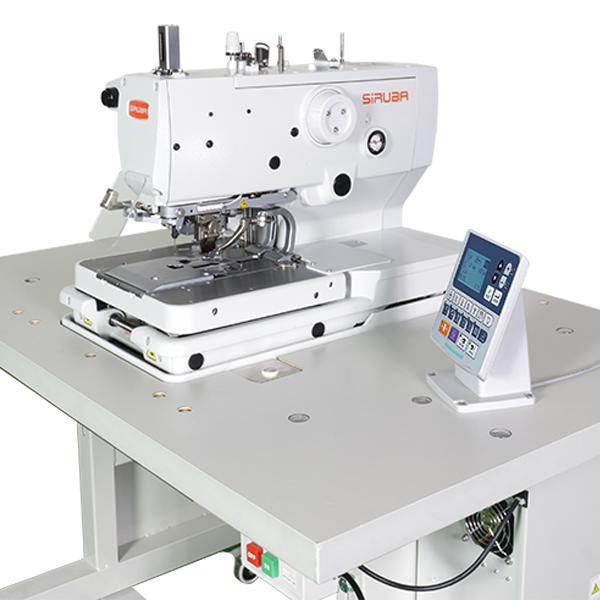 BH-9820E-01 · keyhole specialist
Keyhole buttonholes combine shaped feeding, dense chainstitch overedge sewing, reinforcement and a precisely positioned cut. The BH-9820E-01 coordinates those stages electronically for consistent production.
Recall the required keyhole or straight style and set its length, width, pitch, bartack and cutting sequence.
Align the garment component and activate the work clamp using the configured start control.
Servo/stepper feed forms the programmed shape while the knife cuts before or after sewing as selected.
Both threads are trimmed with the -01 long-tail finish, and the clamp lifts for the next piece.
The BH-9820 platform supports eyelet/keyhole and straight buttonholes with selectable reinforcement styles. Available results depend on the installed knife, hammer, clamp and gauge parts.
A flowing reinforced finish often chosen for tailored keyholes.
A defined cross-bar finish at the end of the buttonhole.
A rounded reinforcement profile for selected styles.
A clean shaped opening without a programmed end bar.
Non-eyelet buttonhole patterns from 5–42mm.
Jackets, waistcoats, coats and trousers requiring consistent keyhole or straight buttonholes.
Programmable repeatability for production lines, tailoring rooms and short-run manufacturing.
Structured shirts, overshirts, jackets and trousers with varied button sizes and hole styles.
Coats and structured garments where a rounded eye distributes strain around the button shank.
Consistent, professional openings across repeated garments, sizes and production batches.
Selected workwear applications after confirming the material stack, gauge and trim requirement.
Quick electronic pattern changes reduce mechanical adjustment when styles vary through the day.
Build and refine production-ready buttonhole specifications before bulk manufacture.
Three stepper motors control X, Y and rotational movement, keeping the programmed outline accurate at production speed.
Set buttonhole length, stitch pitch, overedge width, eyelet size and bartack details around the garment specification.
Choose cutting before or after sewing according to the material, finish and production method.
Make precise knife-spacing and position corrections through the panel instead of relying only on mechanical adjustment.
Icons and characters make pattern selection, checking and mode changes easier for the operator to understand.
Specially processed gears and cams are designed to reduce vibration and lower measured noise versus earlier construction.
Updated looper, take-up and bobbin-thread clamping help reduce skipped stitches and unstable thread tails.
Thread trimming, electronic thread clamping, presser-foot lifting and needle positioning support a smooth cycle.
Focused illumination makes alignment marks, the clamp area and sewn result easier to inspect.
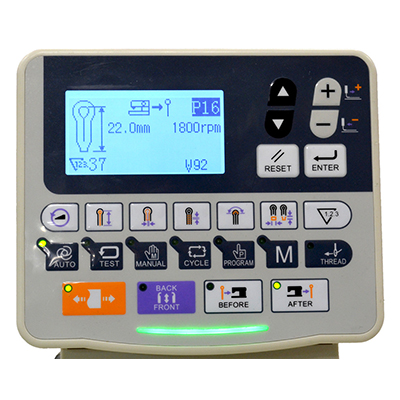
The graphical LCD panel helps the operator select a stored pattern, review its dimensions, adjust speed and work through test or manual modes before production begins.
The BH-9820E-01 is the long-tail subclass. It trims both the needle and bobbin threads but intentionally leaves longer ends than the -02 short-trim configuration.
They give the operator or subsequent process more thread to hold and manage, supporting secure handling through tailoring operations.
“Automatic trim” does not promise an ultra-close cosmetic finish. A secondary finishing trim may be part of the workroom method.
It combines versatile 5–42mm straight and 8–42mm eyelet ranges with trimming of both threads for menswear and casualwear.
| Feature | BH-9820E-00 | BH-9820E-01 this machine |
BH-9820E-02 |
|---|---|---|---|
| Primary application | Suiting and womenswear; extended buttonhole length | Menswear, tailoring and casualwear | Jeans, trousers and workwear |
| Needle-thread trim | Long tail | Long tail | Short tail |
| Bobbin-thread trim | No automatic lower-thread trim | Long tail | Short tail |
| Keyhole length | 8–50mm | 8–42mm | Selected gauge ranges from 14–42mm |
| Straight-hole length | Up to 50mm | 5–42mm | Gauge-specific ranges |
| Choose it when | The longest 50mm range matters more than lower-thread trimming | You want versatile menswear lengths and automatic trimming of both threads with manageable tails | Short thread tails and jeans/trouser production are the priority |
Subclass availability and E-series configuration can vary by market. Direct Sewing will confirm the exact supplied specification before order.
| Model | Siruba BH-9820E-01 |
|---|---|
| Machine type | Direct-drive programmable electronic eyelet/keyhole buttonholing machine |
| Stitch formation | Two-thread chainstitch buttonhole overedge formation |
| Primary application | Menswear, tailoring, suiting and casualwear |
| Keyhole / round-head sewing length | 8–42mm |
| Straight buttonhole sewing length | 5–42mm |
| Sewing shapes | Keyhole and straight patterns with no bartack, taper bartack, straight bartack, round bartack and compatible circular-stitch options |
| Maximum sewing speed | 2,500 stitches per minute |
| Speed setting range | 1,000–2,500 stitches per minute, adjustable in programmed settings |
| Stitch pitch | 0.5–2.0mm |
| Overedge / zigzag width | 1.5–5.0mm electronic adjustment range; 4.0mm mechanical maximum plus compensation to 5.0mm |
| Factory overedge width | 2.5mm for the -01 general menswear specification |
| Taper-bartack length | 0–20mm |
| Work-clamp lift | 12mm standard; configuration up to 16mm possible |
| Standard presser-foot length | 30mm |
| Standard hammer/anvil length | 22mm |
| Accessory hammer/anvil length | 30mm |
| Feed mechanism | Intermittent programmable feed controlled by three stepper motors: X, Y and rotational θ |
| Needle system | DO × 558, Nm80–Nm120 |
| Needle-thread trimming | Automatic long-tail trim |
| Bobbin-thread trimming | Automatic long-tail trim |
| Automatic functions | Thread trimming, electronic thread clamping, presser-foot lifting and needle positioning |
| Cutting sequence | Knife cut before or after sewing, programmable by operation |
| Control panel | Graphical multi-language LCD with icon and character display |
| Upper-shaft motor | 550W AC servo motor |
| Air pressure | Main regulator 0.5MPa; hammer-pressure regulator 0.4MPa |
| Rated air consumption | 43.2L/min at 8 cycles per minute |
| Control power specification | 400VA; exact NZ electrical version to be confirmed before supply |
| Safety | Emergency-stop function and safety-circuit automatic stop |
| Approximate component weight | Machine head 120kg; panel 0.6kg; control box 14.2–16.2kg depending on supplied version |
It automatically sews and cuts programmable keyhole/eyelet and straight buttonholes using a specialised two-thread chainstitch formation. The operator positions the garment and selects the program; the machine controls the shaped feed, stitching, cut, thread trim and clamp cycle.
It has a rounded eye at one end of a narrow slit. The eye gives the button shank room to sit and helps distribute strain, which is why keyholes are common on tailored jackets, coats, waistcoats and trousers.
The -01 specification is aimed primarily at menswear and casualwear. It covers keyholes from 8–42mm and straight holes from 5–42mm, and automatically trims both needle and bobbin threads with longer tails.
The E-series adds the current electronic operator package described by Siruba, including automatic thread trimming, electronic thread clamping, automatic presser-foot lifting, needle positioning, LED lighting and LCD control. Exact regional configuration is confirmed at quotation.
The -01 specification covers keyhole/round-head buttonholes from 8–42mm and straight buttonholes from 5–42mm, subject to the installed knife, hammer, clamp and gauge parts.
Yes. The programmed sewing range includes straight non-eyelet buttonholes. The physical cutting parts must match the intended hole.
Round-hole operation is possible on the -01 platform when fitted with the appropriate optional knife, hammer/anvil and gauge parts. Confirm the required diameter when requesting a quotation.
The platform supports no bartack, taper, straight and round bartack patterns, plus compatible circular-stitch shapes. The chosen program and installed gauge set determine the final result.
Yes. The pneumatic knife and hammer system cuts the opening. Cut-before or cut-after sewing can be selected according to the material and production method.
Yes. The -01 trims both needle and bobbin threads, leaving longer tails than the short-trim -02 specification.
Longer tails give the operator or subsequent production process more thread to grip and manage securely. This is a deliberate production specification and may be followed by a cosmetic finishing trim.
Up to 2,500 stitches per minute. Sewing speed can be programmed from 1,000–2,500 stitches per minute to suit the material, thread and buttonhole.
Three stepper motors control X, Y and rotational feed movement according to the stored sewing data. This gives the machine precise control over the eye, legs and reinforcement pattern.
Many dimensions and sewing parameters are changed at the LCD panel, but the knife, hammer/anvil, clamp and gauge set still define important physical limits. A different cut size may require parts as well as a program change.
It is positioned for menswear, tailoring, suiting and casualwear. The correct result depends on the complete garment stack—including shell fabric, canvas, interlining, facing and seam allowance—so production samples should be tested.
Selected applications may be possible, but Siruba positions the -02 short-trim subclass specifically for jeans, trousers and workwear. Compare the actual material, hole length and desired thread tails before choosing.
It can sew straight industrial buttonholes within the specified range, but it is a specialist chainstitch eyelet-buttonhole platform. For conventional lightweight shirt production, a dedicated lockstitch buttonholer may be a more economical match.
Yes. Siruba specifies 0.5MPa at the main regulator and 0.4MPa at the hammer regulator, with stated consumption of 43.2L/min at eight cycles per minute. A clean, dry, regulated supply is essential.
Do not assume so. Compressor size, receiver, filtration, drying and connections should be specified for the installation and other equipment sharing the air supply. Direct Sewing will confirm what is included in the quotation.
The BH-9820 platform is manufactured in several voltage configurations. Direct Sewing must confirm the exact NZ-supplied version and site requirements before installation; do not arrange electrical work from a generic overseas specification.
DO × 558 needles in sizes Nm80–Nm120 are specified. Needle size, thread and point must be selected for the garment stack and buttonhole program.
No single setup covers every possible length, cut and round-hole size. The quotation should list the standard installed gauge and any additional knives, hammers/anvils, clamps or optional parts required for your garments.
Yes. The electronic system is intended for programmable pattern setup and rapid recall, making the machine well suited to short runs and mixed garment styles.
The machine head alone is approximately 120kg, with a separate control box and full industrial workstation. Delivery access, floor position, unloading and installation must be planned in advance.
Yes—and for this class of machine, that is strongly recommended. Supply complete production stacks, the proposed thread, button size, required hole dimensions and an approved finish sample where possible.
Professional setup and operator training are strongly recommended. Pattern programming, gauge selection, thread handling, knife alignment, pneumatic settings and daily cleaning all affect the production result.
Send Direct Sewing your garment samples, button dimensions, required keyhole styles, thread and expected daily volume. The team can then confirm whether the BH-9820E-01 is the right subclass and quote the correct gauges, air requirements, delivery and setup.