The sensor detects material at the sewing area and the electric lifter controls the presser foot for loading.

Sensor-controlled industrial overlocking
Brother FB-N21A: four-thread seaming with less stopping and reaching
A high-speed two-needle, four-thread overlocker that senses the fabric, controls the presser foot and cuts the finished thread chain automatically—helping production move from one garment piece to the next with fewer manual steps.
- Automatic electric foot lift raises and lowers the presser foot in response to the fabric sensor.
- Automatic chain/tape cutter cuts the thread chain after the material passes the sensor.
- Built-in direct-drive motor gives responsive speed control without an idling clutch motor.
- Four-thread differential-feed overlocking joins and finishes light-to-medium fabric in one operation.
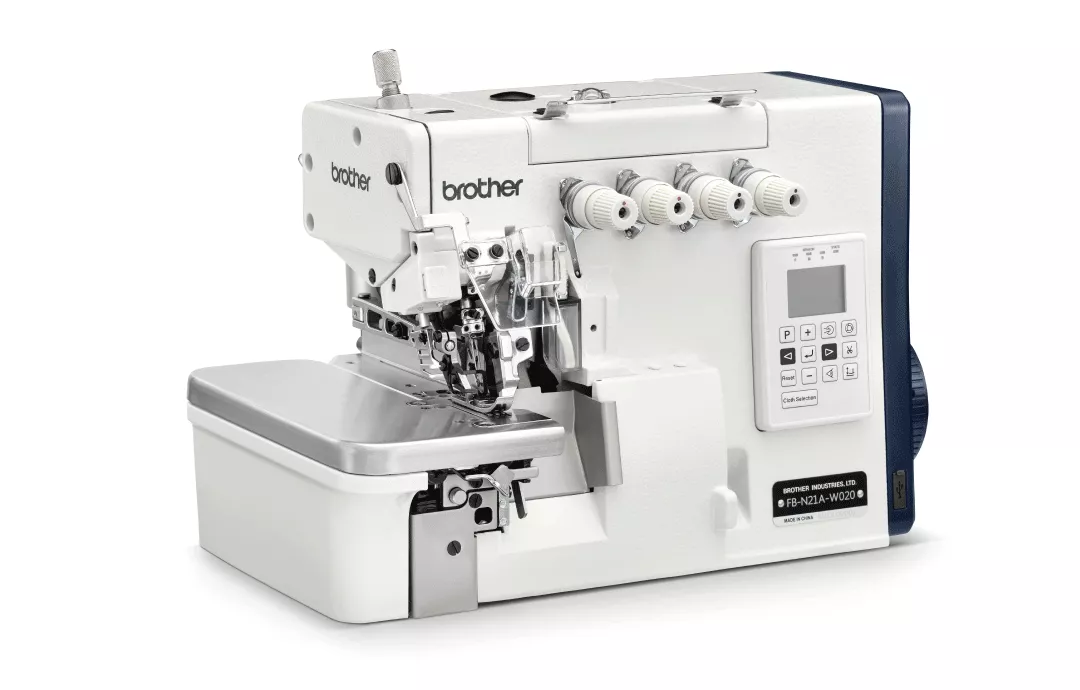 FB-N21A · N21A-W020 cutter package
2 needles / 4 threadsSeam and overedge in one operation
6,500 sti/minMaximum sewing speed
0.7–4.0mmAdjustable stitch length
DC × 27 #11Industrial overlock needle system
Fabric arrives. The machine handles the routine movements.
The FB-N21A is designed to remove repeated hand and knee movements from high-volume overlocking. Its sensor links material detection with the electric foot lift and thread-chain cutting cycle.
Two needles and two loopers form a flexible overlock seam while differential feed manages the fabric.
After the material clears the sensor, the presser foot lifts and Brother's cutter separates the thread chain.
Brother's terminology: the manufacturer calls this device an “Automatic Tape Cutter”, but describes it as cutting the thread chain after the sensor detects the material. “Automatic chain/tape cutter” is the clearest description of what the fitted system does.
Built for repeat overlocking on light-to-medium materials
Knitwear production
Join and finish jersey, interlock and other suitable knit garment seams with flexible four-thread formation.
T-shirts
Efficient side, shoulder and sleeve seams where a production overlock stitch is the appropriate construction.
Alteration rooms
Professional edge finishing and knit-seam reconstruction when speed and consistent handling matter.
Sample rooms
Fast, adjustable overlocking with differential feed for changing garment fabrics and prototypes.
Production lines
Sensor-controlled lift and chain cutting reduce repetitive handling between consecutive pieces.
Homewares
Construction and edge finishing on suitable pillowcases, bedding and light furnishing materials.
Choose the stitch class as carefully as the brand. The FB-N21A forms a two-needle, four-thread overlock seam. If the job requires a separate chain-stitch safety seam for heavier woven production, compare a five-thread safety-stitch machine such as Brother's FB-N31A family.
Brother automation, shown where it works
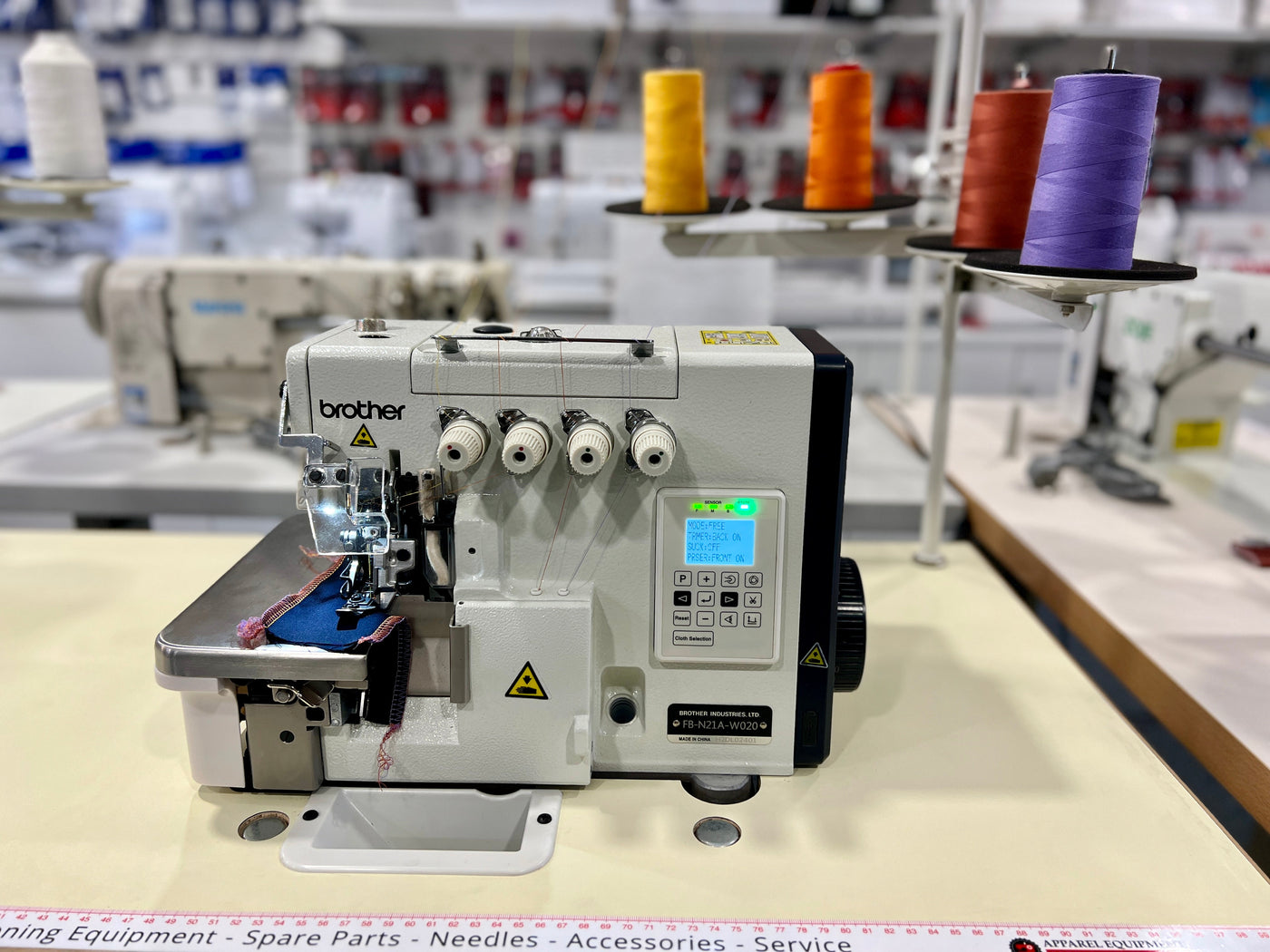
Electric presser-foot lifter
Keep your hands on the next piece—not on the foot lever
Brother's sensor-controlled electric lifter automatically raises and lowers the presser foot as material arrives and leaves the sewing area. That shortens the transition between pieces and reduces the repeated motions that accumulate across a production shift.
- Automatic lift/drop linked to material detection
- Faster loading and removal between pieces
- Both hands remain available to align the fabric
- 5.5mm maximum presser-foot lift
- Designed for repeat light-to-medium work
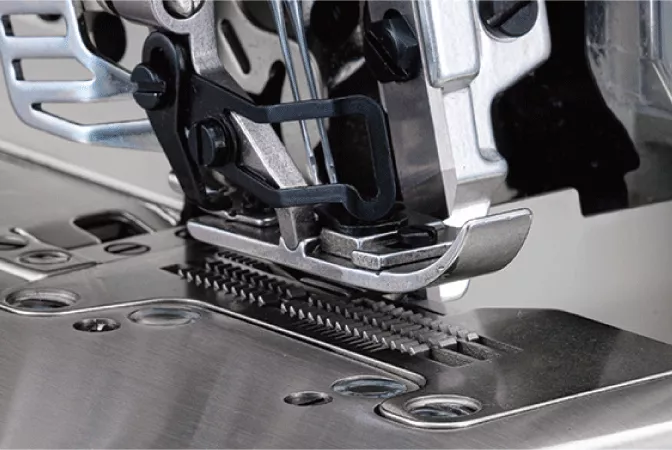
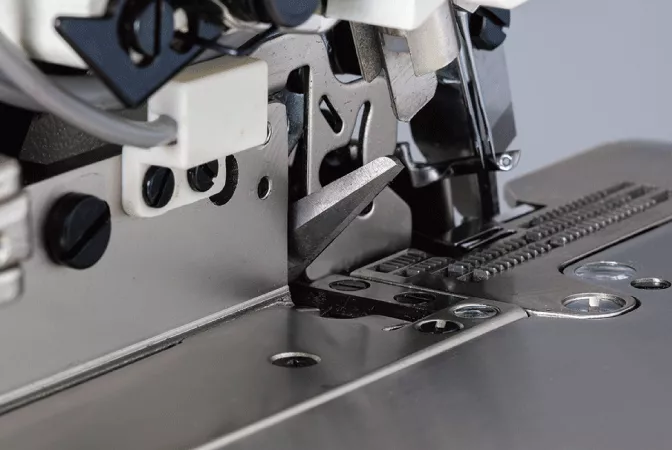
Automatic chain/tape cutter
End the seam without reaching for snips
When the material passes the sensor, the fitted cutter separates the thread chain automatically. The operator can remove the finished piece and present the next one without stopping to find scissors or leaving a long chain between garments.
The cutter is the key distinction between Brother's N21A-W020 and the W020P column in the current specification. Direct Sewing's package is presented with the cutter; confirm the subclass plate at dispatch.
Built-in direct drive
Power where the machine needs it
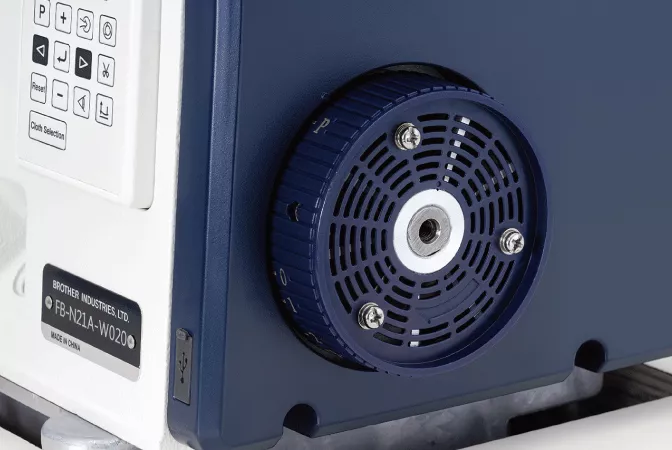
The motor is built into the overlocker head for responsive acceleration and controlled running without the constant idle noise of a traditional clutch motor. Set a comfortable maximum speed and use the treadle for variable control.
- Fast response when the treadle moves
- No separate clutch motor idling beneath the table
- Adjustable operating speed
- Cleaner, more compact drive arrangement
- Up to 6,500 stitches per minute when the work permits
Construction and edge finishing in the same pass
The second needle adds strength and seam security compared with a basic one-needle, three-thread overedge.
The loopers wrap the trimmed edge to create the familiar flexible overlock finish.
The specified overedge formation covers the cut edge while the two needles are spaced 2mm apart.
Adjust the front-to-rear feed relationship from 0.7 to 1.5 to help control stretching or gathering.
Set a shorter or longer formation to suit fabric, seam appearance and the production operation.
The overlock knives trim the fabric edge before the loopers wrap it for a consistent finished seam.
Control the fabric before it controls the seam
Two feed-dog sections can move the material at different rates. That gives the operator a direct way to respond when knits stretch, fine fabrics ripple or an operation intentionally needs controlled gathering.
A lower differential setting can help stretch the edge intentionally for selected effects and operations.
Balanced feeding suits fabrics that pass cleanly without unwanted stretching or gathering.
A higher setting feeds more material into the seam, helping counter stretch or create controlled gathering.
Always test the real fabric. Differential feed does not have one universal “correct” number. Fabric recovery, grain direction, stitch length, presser pressure, thread and operator handling all influence the result.
Four-thread overlock, plain sewing or five-thread safety stitch?
| Machine type | FB-N21A — this machine | Industrial plain sewer | Five-thread safety stitch |
|---|---|---|---|
| Stitch formation | Two-needle, four-thread overlock | Two-thread straight lockstitch | Chain stitch plus separate overedge |
| Primary role | Join and finish flexible/light-to-medium seams in one pass | Construction seams, topstitching, zips and precision straight work | Secure woven production seams with overedge finish |
| Trims fabric edge | Yes | No | Yes |
| Differential feed | Yes, 0.7–1.5 | No | Commonly fitted; specification varies |
| Automatic chain cutting | Yes, on the Direct Sewing W020 cutter package | Not applicable | Available on selected configurations |
| Best fabric match | Light-to-medium knit and woven work | Depends on machine subclass and feed system | Medium/heavier woven production |
Most production rooms use more than one stitch class. The FB-N21A complements a plain sewing machine; it does not replace straight construction, topstitching, zip insertion, buttonholes or coverstitch hemming.
Where the FB-N21A earns its place
T-shirts
Flexible side, shoulder and sleeve seams on suitable jersey and interlock constructions.
Casual knitwear
Light sweatshirting, loungewear and everyday knit garments within the machine's range.
Woven edge finishing
Clean, secure seam-edge finishing on suitable light-to-medium woven garments.
Alterations
Reconstruct overlocked seams and restore professional internal finishing.
Samples
Develop production-ready garment construction while testing differential feed and stitch length.
Repeat batches
Sensor-controlled lift and cutting make transitions faster across consecutive pieces.
Bedding
Fast internal seams and edge finishing on suitable pillowcases, sheets and light homewares.
Controlled gathering
Use differential feed intentionally where the operation calls for eased or gathered fabric.
Brother FB-N21A at a glance
| Current Direct Sewing SKU | FBN21A |
|---|---|
| Official model | Brother FB-N21A |
| Likely package subclass | N21A-W020: electric presser-foot lift and automatic chain/tape cutter; confirm model plate |
| Machine type | High-speed industrial overlock sewing machine |
| Fabric range | Light-to-medium materials |
| Needles / threads | Two needles / four threads |
| Needle spacing | 2mm |
| Overedge width | 4mm |
| Stitch length | 0.7–4.0mm |
| Differential-feed ratio | 0.7–1.5 |
| Maximum sewing speed | Up to 6,500 stitches/min |
| Presser-foot lift | Up to 5.5mm; sensor-controlled electric lifting on the W020 package |
| Needle system | DC × 27 / B-27; Brother standard specification #11 |
| Drive | Built-in direct-drive motor |
| Automatic cutter | Brother automatic tape cutter, described by Brother as cutting the thread chain after material detection |
| Fabric trimming | Integrated overlock knives trim the fabric edge as the seam is formed |
| Lighting / control | Direct Sewing package lists LED sewing-area illumination, user-friendly panel and adjustable speed |
| Optional lint collection | Brother air-suction lint collector available separately; confirm compatibility and air requirements |
| Power | Integrated industrial direct-drive configuration; confirm the exact current NZ voltage, lead and plug |
A complete automatic overlocking station
The current Direct Sewing page presents the FB-N21A built into an industrial table and stand with the direct-drive system, thread stand, wheels and starter accessories. Confirm the exact contents and delivery format before dispatch.
- Genuine Brother FB-N21A head
- Two-needle, four-thread stitch formation
- Built-in direct-drive motor
- Differential feed and fabric-edge knives
- LED sewing-area illumination
- Material-detection sensor
- Electric presser-foot lift/drop
- Automatic chain/tape cutter
- Adjustable operating speed
- Operator control panel
- Industrial table and stand
- Speed-control treadle
- Four-cone thread stand
- Built-up machine arrangement
- Wheels/castors for easier repositioning
- Confirm current finish
- Sewing-machine oil
- Industrial overlock needles
- Screwdriver / setup tool
- Instruction information
- Confirm current quantities and tool pack
- No bobbins are required by this machine
- DC × 27 / B-27 needles
- Quality industrial overlock thread
- Specified clear industrial sewing-machine oil
- Replacement upper and lower knives when worn
- Brother lint collector
- Air supply or suction requirements
- Current table, stand and castor details
- NZ electrical connection
- Installation, training and delivery access
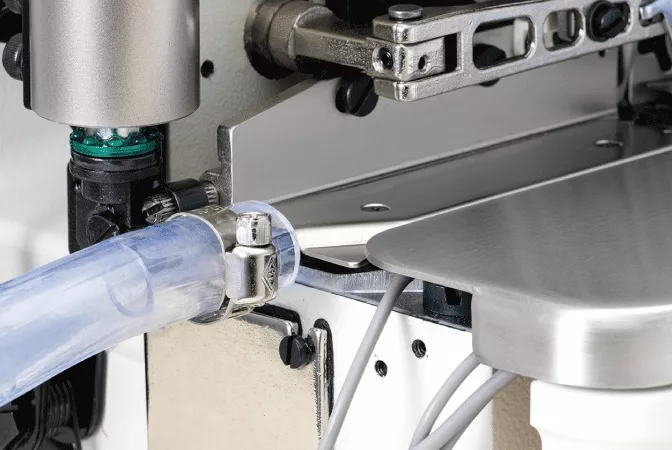
Optional lint control
Keep chain and trimming waste moving away from the work
Brother offers an optional air-suction lint collector to remove thread chain and/or trimmed material. It can help keep a busy overlock station tidier, particularly where the same operation runs throughout the day.
The lint collector is not included in the standard package described here. Confirm the correct kit, installation and air-supply requirements with Direct Sewing.
Brother FB-N21A
Brother's current page covers the sensor-controlled foot lift, chain/tape cutter, direct drive, optional lint collector and official specifications.
View Brother Product PageFB-N21A / FB-N31A catalogue
Review Brother's overlock and safety-stitch family, subclass differences, stitch formations and technical specification.
Open Official CatalogueFB-N21A / FB-N31A manual
Direct Sewing's locally hosted instruction reference for safe setup, threading, operation, adjustment and maintenance.
Open Instruction ManualDirect Sewing brochure
A convenient locally hosted copy of the correct FB-N21A / FB-N31A product information.
Open Local BrochureDC × 27 / B-27 overlock needles
Use the correct industrial needle system and choose the appropriate point and size for the fabric and thread.
View Compatible NeedlesTalk with Direct Sewing
Discuss materials, stitch choice, model subclass, demonstration, delivery, training, parts and New Zealand support.
Contact Direct SewingWhat to know before choosing the Brother FB-N21A
What exactly is the Brother FB-N21A?
It is a high-speed industrial overlocker for light-to-medium materials. This configuration uses two needles and four threads, differential feed, built-in direct drive, sensor-controlled electric foot lift and an automatic chain/tape cutter.
Is FBN21A the official model name?
Brother styles the model as FB-N21A. Direct Sewing's Shopify handle and SKU omit the hyphen, which can remain unchanged to preserve existing links and records.
Which FB-N21A subclass is this?
Direct Sewing's fitted automatic chain/tape cutter matches Brother's N21A-W020 specification. Confirm the subclass on the physical model plate before dispatch or before placing W020 in permanent Shopify fields.
What is the difference between N21A-W020 and W020P?
Brother's current specification lists the automatic tape cutter for W020 and marks it not applicable for W020P. Their sewing specifications are otherwise presented with the same light/medium, two-needle, four-thread format.
How many needles and threads does it use?
It uses two needles and four threads: two needle threads and two looper threads.
What kind of stitch does it make?
It forms a two-needle, four-thread overlock seam that can join suitable layers while trimming and wrapping the raw edge in one operation.
Is it a three-thread overlocker?
No. The Direct Sewing FB-N21A specification is a two-needle, four-thread machine. Do not describe it as a one-needle, three-thread edge-finisher.
Is it a five-thread safety-stitch machine?
No. A five-thread safety stitch combines a separate chain stitch with an overedge. The FB-N21A uses four-thread overlock formation. For heavier woven production requiring a safety stitch, ask about Brother FB-N31A configurations.
What does the automatic presser-foot lifter do?
A material sensor controls the electric lifter so the foot can raise and lower automatically as fabric is presented and removed, reducing repeated hand or knee movements.
What does the automatic tape cutter cut?
Brother calls it an automatic tape cutter and states that it cuts the thread chain after the sensor detects the material. This separates the finished piece from the machine without manual snips.
Does it cut the fabric edge too?
Yes. The standard overlock knives trim the raw fabric edge as it is sewn. The separate automatic chain/tape cutter cuts the thread chain after the piece leaves the sewing area.
Does it have automatic thread trimming like a plain sewer?
Its automatic finishing device is designed around overlock chain separation. It cuts the thread chain after material detection rather than using the lockstitch bobbin-and-needle trimmer found in an automatic plain sewer.
Who is the FB-N21A best suited to?
Garment production, knitwear makers, alteration rooms, sample rooms and serious studios that perform frequent four-thread overlocking on light-to-medium materials.
What fabrics can it sew?
Brother specifies light-to-medium materials. Typical work includes suitable jersey, interlock, light sweatshirting, apparel wovens and light homewares. Needle, thread, differential feed and stitch length must match the actual fabric.
Is it good for T-shirts?
Yes. Four-thread overlock is widely used for suitable T-shirt side, shoulder and sleeve seams. Test fabric recovery, differential feed, thread and seam stretch before production.
Can it sew woven fabric?
Yes, within its light-to-medium range. It can join suitable woven seams or finish raw edges, but a plain sewer or five-thread safety stitch may be preferable for certain construction methods.
Can it sew heavy denim, canvas or upholstery?
It is not the correct primary machine for heavy denim stacks, upholstery, heavy canvas, leather or webbing. Those jobs need an appropriate heavy-material specification and often a different feed or stitch class.
How fast is the FB-N21A?
Brother specifies up to 6,500 stitches per minute. Actual working speed should suit the material, seam, operator and quality target.
Do I have to sew at full speed?
No. Direct Sewing lists adjustable speed, and the direct-drive treadle provides variable control. Start lower while learning, threading, testing differential feed or sewing detailed curves.
What is the stitch-length range?
Brother specifies 0.7–4.0mm.
What is the needle spacing?
The two needles are spaced 2mm apart in the standard N21A-W020 configuration.
What is the overedge width?
Brother specifies a 4mm overedge width. Brother notes that other gauges may be available in some markets; confirm any conversion with Direct Sewing.
What does differential feed do?
It changes the relative movement of the front and rear feed dogs. This helps control stretched or rippled knit seams, can reduce puckering, and can create controlled gathering when deliberately adjusted.
What is the differential-feed range?
Brother's current FB-N21A product specification lists a ratio of 0.7–1.5.
Which needles does it use?
It uses DC × 27 needles, also commonly labelled B-27. Brother lists #11 as the standard specification. Select the correct point style and size for the fabric and thread.
Can I use domestic overlocker needles?
Only if they carry the exact DC × 27 / B-27 system required by the machine. Do not substitute domestic sewing needle systems that differ in length or shank design.
Does this overlocker use bobbins?
No. It forms stitches with needle threads and loopers, so there is no bobbin. The old accessory wording mentioning bobbins should be removed from the product page.
How high does the presser foot lift?
Brother specifies up to 5.5mm.
What does direct drive mean?
The motor is integrated with the machine head for quick response and controlled running. It avoids the constant idle operation associated with a traditional clutch motor.
Does it have a sewing light?
Yes. Direct Sewing lists LED illumination for the sewing area.
Is the lint collector included?
No. Brother identifies the air-suction lint collector as an option. Confirm the correct kit, installation and any air-supply requirement separately.
Does it come with a table and stand?
The current Direct Sewing page presents a built-up industrial workstation with table, stand, treadle, thread stand and wheels. Confirm the current finish, assembly and delivery format when ordering.
What accessories are included?
The current page lists oil, a screwdriver and needles. Because an overlocker does not use bobbins, that old item is excluded here. Confirm current quantities and the complete tool/accessory pack before dispatch.
Is it portable?
No. It is a full industrial workstation intended for permanent floor space. Wheels help reposition the assembled table, but it is not a portable domestic overlocker.
What power supply does it require?
Confirm the exact current New Zealand stock voltage, lead and plug with Direct Sewing. Electrical installation and service should be handled according to Brother's instructions by appropriately qualified personnel.
Can I test my own fabric before buying?
Contact Direct Sewing to confirm demonstration availability. Bring the actual fabric, thread, seam type and layer count so the team can test differential feed, stitch length, speed and sensor operation.
What should I confirm before delivery?
Confirm the N21A-W020 model plate, fitted cutter and electric lifter, table and wheel configuration, included accessories, NZ electrical connection, assembled dimensions, access, freight method, installation, training and current support terms.
Bring your fabric and watch the automatic cycle work.
The FB-N21A is most convincing when you see the foot lower, the seam form and the chain separate without extra handling. Talk with Direct Sewing about a demonstration, current subclass, workstation package, delivery and New Zealand support.